

Key Highlights
- A li socl2 3.6 v battery has a self-discharge rate of less than 1% per year and provides a maintenance-free lifespan of 10 to 20 years.
- These batteries operate reliably from -40°C to +85°C, making them ideal for sensors embedded in freezing ground or hot asphalt.
- Lisocl2 chemistry offers the highest energy density among primary lithium batteries, maximising capacity in small form factors.
- Integrating a li socl2 battery with a Hybrid Pulse Capacitor (HPC) enables the high-current bursts (up to 2A) required for LoRaWAN and NB-IoT transmissions.
- PKCELL’s specialised HPC technology effectively eliminates the “passivation” effect, ensuring the sensor wakes up and transmits data instantly every time.
Introduction
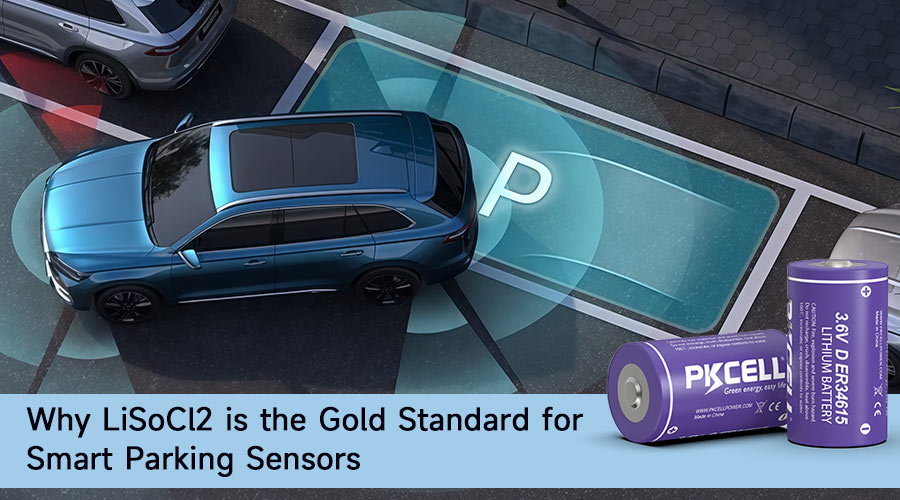
The global smart parking market is currently expanding at a CAGR of approximately 18-20%, with projections to surpass $16 billion by 2028. As cities transition toward intelligent transportation, the demand for “install-and-forget” sensors is skyrocketing. However, the biggest hurdle for these IoT devices isn’t the software—it’s the power. Smart parking sensors, whether surface-mounted or buried underground, face extreme thermal stress and must operate for a decade without a single battery change.
For product designers and engineers, the li socl2 battery (Lithium Thionyl Chloride) has become the undisputed choice for these demanding environments.
Overcoming the Pulse Current Problem
Most smart parking sensors utilize LPWAN technologies like LoRaWAN, NB-IoT, or Sigfox. While these modules consume only microamps in sleep mode, they require sudden “bursts” of current—often reaching 500 mA to 2A—during data transmission.
A standard “bobbin-type” lisocl2 battery is designed for low-drain applications. When hit with a high-power pulse, it may experience a “voltage delay” due to a passivation layer that forms on the lithium anode during storage. To solve this, the li socl2 3.6 v battery can be paired with a Hybrid Pulse Capacitor (HPC). The battery continuously trickle-charges the HPC, which acts as a power reservoir, delivering the necessary current for transmission without stressing the battery cell.
Designing for the Environment: Pavement vs. Underground
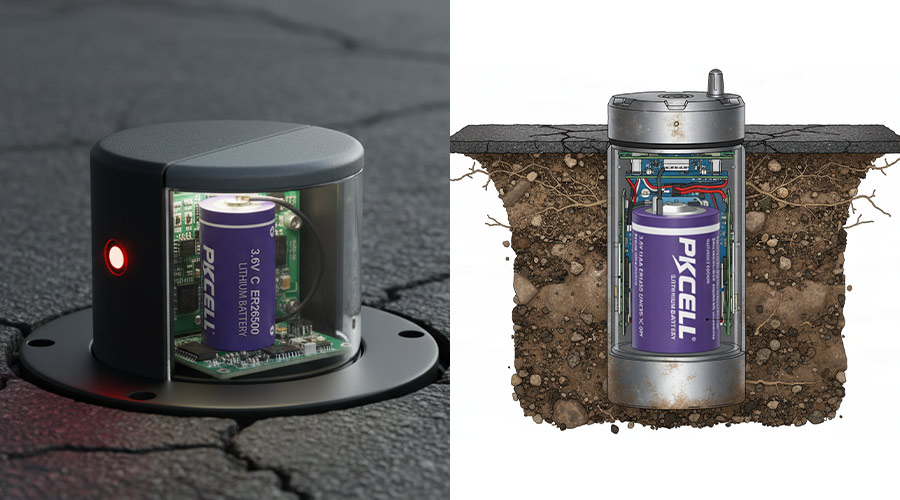
Smart parking sensors are essentially “outdoor electronics in a box.” Those embedded in asphalt must withstand the “heat island” effect, where temperatures can exceed 70°C in the summer. Conversely, underground sensors face high humidity and corrosive soil conditions.
Using glass-to-metal (GTM) hermetic sealing for all ER batteries is the best solution for the problem. This industrial-grade seal prevents electrolyte leakage and moisture intrusion, ensuring the battery’s internal chemistry remains stable for over a decade, regardless of external environmental pressure.
LiSoCl2 + HPC Specification Table for Reference-PKCell Power Solutions
|
ER14250+HPC1520
|
1/2 AA | 1,200 mAh | 1,000 mA | Sigfox / LoRaWAN |
|
ER14505+HPC1520
|
AA | 2,700 mAh | 2,000 mA | LoRaWAN / NB-IoT |
|
ER26500+HPC1550
|
C | 9,000 mAh | 3,000 mA | High-Traffic NB-IoT |
|
ER34615+HPC1550
|
D | 19,000 mAh | 3,000 mA | Gateway / Repeater |
LiSoCl2 + HPC Pack for Canadian Smart Parking Sensors-Case Study
A Canadian smart city technology firm faced a critical challenge: its outdoor parking sensors were failing because of the sub-zero temperatures. Standard batteries couldn’t handle the high-power pulses needed for data transmission in the cold, and this led to “voltage delay” and sensor disconnects.
The PKCELLPOWER Solution: After analyzing the sensor’s power profile, PKCELL recommended a specialized 3.6 v li socl2 hybrid solution. While the company initially tested individual cells like the ER14505 and ER26500, the final design utilized the ER26500 + HPC1520 battery pack.
By integrating a Hybrid Pulse Capacitor (HPC), PKCELL creates a reservoir of energy. The li socl2 battery slowly charges the HPC, which then handles the 1A-2A pulse current during data transmission. This synergy ensures the device stays online and extends the total operational life by up to 15%.
- Result: The sensors maintained a stable 3.6 v li socl2 output even at -40°C.
- Outcome: The client successfully deployed thousands of units across North America, reporting a projected maintenance-free lifespan of over 15 years.
PKCELL Power: Your Professional B2B Battery Partner
Shenzhen PKCELL Battery Co., Ltd. is a leading Chinese manufacturer with over 20 years of battery manufacturing experience. PKCell Power has expertise in the primary lithium sector. Our 28,000-square-meter facility is equipped with 18 high-speed automated production lines, producing over 500 billion pieces annually.
We understand that B2B clients require more than just a component; they need a certified, reliable supply chain. PKCELL is ISO9001 certified, and our lisocl2 products carry CE, RoHS, UN38.3, and IEC62133 certifications. From custom battery pack design to rigorous quality testing, our 50+ person R&D team ensures your smart city infrastructure is powered by the best.
Reduce your maintenance costs and enhance your sensor reliability with PKCELLPOWER’s advanced battery solutions.
FAQs
Q: What is the difference between Li-SoCl2 and Li-MnO2 for parking sensors?
A: Li-MnO2 (3.0V) is excellent for lower-cost consumer goods, but 3.6 v li socl2 is superior for industrial IoT. It offers higher energy density, a much wider temperature range, and a significantly longer shelf life (10+ years vs. 5-7 years).
Q: How do I calculate the actual IoT sensor battery life?
A: Life is calculated by balancing the “sleep current” (usually <10µA), the “pulse current” during transmission, and the self-discharge rate (<1% for PKCELL ER cells). PKCELL provides customized power profile simulations to help engineers estimate lifespan accurately.
Q: Why is an HPC better than a standard supercapacitor?
A: Standard supercapacitors often have high leakage currents and limited temperature ranges. An HPC (Hybrid Pulse Capacitor) from PKCELL is specifically designed to work with li socl2 battery chemistry, offering extremely low leakage and high safety in outdoor environments.
Post time: Jan-26-2026


