

The Role of Primary Lithium Batteries in Disaster Preparedness
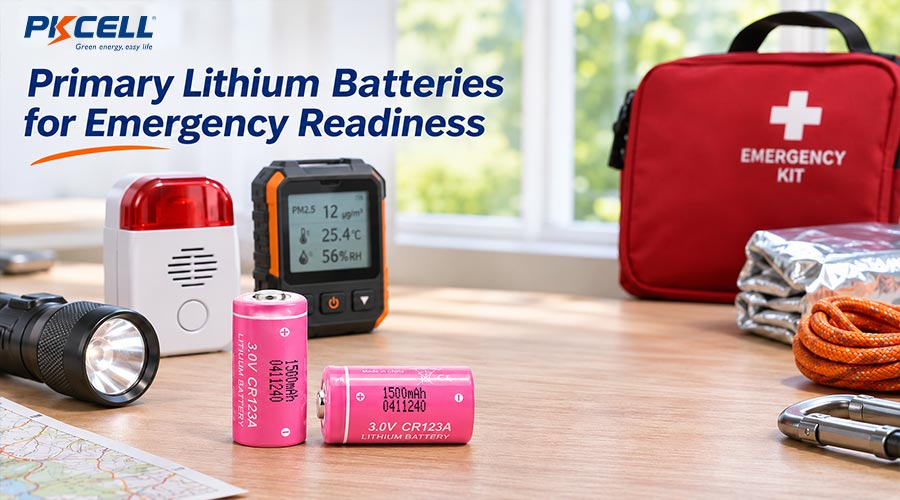
An emergency device has two demanding jobs: it may need to wait for a long time, then work when normal power or maintenance is unavailable. Primary lithium batteries can support that combination in appropriately designed alarms, monitoring equipment and other portable devices.
For equipment manufacturers and emergency planners, the key is not simply choosing a battery with a long shelf life. It is making sure the complete device can start, operate and remain useful throughout the scenario it was designed to handle.
Why Battery Readiness Matters in a Disaster
A disaster can disrupt electricity, access to replacement parts and routine servicing. Equipment that normally depends on a power connection or a maintenance schedule may therefore need an independent energy source.
Primary lithium batteries are non-rechargeable cells intended for use until replacement. Depending on the specific chemistry and product, they can be considered for equipment that spends substantial time in storage or low-power standby. PKCELL’s primary lithium battery solution hub identifies alarms, security devices and remote monitoring among relevant applications.
Where Primary Lithium Batteries Can Support Emergency Preparedness
Detection and Early Warning
Battery-powered smoke alarms, leak detectors and other warning devices may need to remain ready between events. For a manufacturer, that means accounting for background monitoring, self-tests and the energy required to sound or transmit an alarm.
Battery replacement and testing must follow the specific device manufacturer’s instructions. A long-life battery does not eliminate the need to inspect or test the complete alarm.
Remote Monitoring and Situation Awareness
A remote sensor may help teams monitor conditions in places that are difficult to reach during severe weather or other disruptions. Its battery must support normal sensing as well as any increased reporting, retries or local alerts required during an incident.
PKCELL’s ER + HPC battery solutions can be evaluated for devices that combine low standby demand with intermittent higher-current pulses. The complete configuration still needs to be tested against the actual communication and event profile.
Portable and Backup Equipment
Some portable instruments and backup circuits can use primary lithium cells when the equipment is designed and approved for them. Verify the specified battery model, voltage, dimensions, polarity and operating conditions before selecting a replacement.
Primary lithium batteries are not a universal substitute for rechargeable packs, power stations or generators. Choose the power source for the device’s actual workload, expected duration and approved design.
Choose a Battery for Each Stage of the Emergency
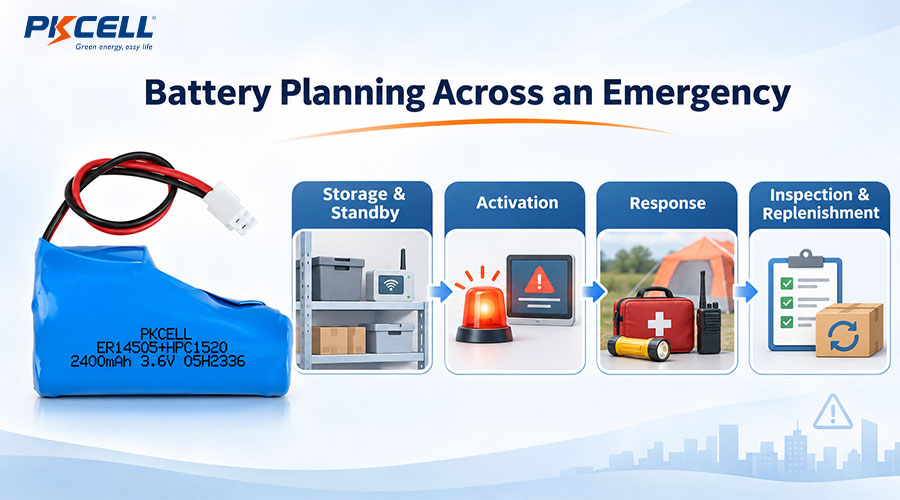
A useful preparedness plan separates the periods before, during and after an event. Each stage places a different demand on the battery.
| Stage | Battery challenge | Practical question |
|---|---|---|
| Before an event | Storage time, standby consumption and environmental exposure | Will the battery and device remain within their specified storage and replacement limits? |
| At activation | Startup, alarm or communication demand after a long rest | Does voltage stay above the device’s minimum requirement under the real load? |
| During the response | Repeated alerts, longer operating time and possible communication retries | Is enough usable energy available for the planned operating scenario? |
| After the event | Inspection, replacement and replenishment | Can the team identify used or damaged equipment and restore its readiness? |
This approach turns a vague requirement such as “long battery life” into a testable operating plan. It also helps buyers decide which devices need spare batteries, replacement packs or a different power architecture.
Which Primary Lithium Chemistry Should You Consider?
Chemistry is a starting point, not a guarantee of compatibility. Compare the exact cell or pack specification with the device’s voltage range, current profile, temperature exposure and mechanical requirements.
Li-SOCl2 for Low-Power, Long-Standby Designs
Lithium thionyl chloride, or Li-SOCl2, cells are often considered for low-average-current devices such as remote sensors. PKCELL lists 3.6 V nominal Li-SOCl2 products for applications including monitoring and industrial sensing.
A long rest can affect how some Li-SOCl2 cells respond to a sudden load. Test the first activation after representative storage, particularly when the device must transmit or produce an alarm immediately. Explore the Li-SOCl2 battery range and review the model-specific specifications before selecting a cell.
Li-MnO2 for Selected Alarms and Compact Devices
Lithium manganese dioxide, or Li-MnO2, batteries are another option for selected security devices and compact equipment. PKCELL’s solution hub lists 3 V nominal Li-MnO2 products and identifies pulse capability as a consideration. Actual performance depends on the cell and operating conditions.
Review the Li-MnO2 battery range when evaluating an existing device specification or a new design. Similar-looking batteries are not necessarily interchangeable.
Custom Packs for Device-Specific Requirements
When a standard cell does not meet the available space, connection or voltage requirements, a purpose-designed assembly may be worth evaluating. PKCELL describes options for custom primary lithium battery packs, including configurations and connection details that can be discussed according to the project.
Planning an Emergency Equipment Project?
Share your device application, voltage limits, operating conditions and expected quantity with PKCELL to discuss suitable batteries, samples or a custom pack.
How to Validate an Emergency Device Battery
A capacity rating alone does not show whether a device will perform throughout an emergency. Build a test plan around the intended mission and the finished equipment.
- Define the scenario. Record storage duration, standby time, event frequency, required operating time and any planned reserve.
- Measure the complete load. Include startup, sensing, alarm output, communications, retries and recovery between events.
- Check voltage under load. Compare the minimum voltage during the demanding event with the device’s operating and reset limits.
- Test representative conditions. Include the specified temperature extremes, relevant storage history and an appropriate near-end-of-life battery condition.
- Inspect the assembly. Verify connector retention, polarity, insulation, enclosure protection and replacement access.
- Confirm the full response path. For connected equipment, check what happens if communications are unavailable; battery power alone cannot ensure that an alert is received.
PKCELL’s primary lithium battery testing guide explains why open-circuit voltage and transport testing do not replace application-specific validation.
Storage and Replacement: Keep the Plan Practical
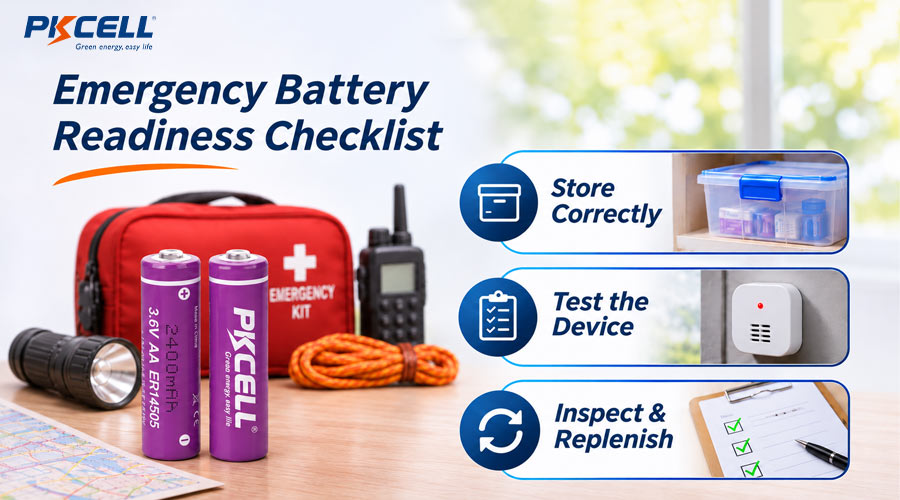
Maintain an inventory of the approved battery models for each device, including quantities, receipt dates and the manufacturer’s recommended storage and replacement information. Protect terminals from short circuits and store batteries in their original packaging where practical, following the battery manufacturer’s instructions.
Do not recharge primary lithium batteries. Do not use damaged cells or mix batteries unless the device and battery manufacturers explicitly permit it. Keep small button cells away from children and follow local collection and disposal requirements.
After an incident or exercise, inspect equipment and replenish used supplies. Record any problems with installation, startup or replacement so the next preparedness cycle is easier to manage.
Frequently Asked Questions
Are primary lithium batteries rechargeable?
No. Primary lithium batteries are non-rechargeable. Use only the battery type specified for the equipment and follow the manufacturer’s replacement instructions.
Can a primary lithium battery replace an alkaline battery?
Only when the device manufacturer permits the exact replacement. Matching the physical size is not enough: voltage, current capability and other characteristics must also be compatible.
Is a long shelf life the same as a long emergency runtime?
No. Shelf life concerns storage under specified conditions. Runtime depends on the installed device, its load, temperature, battery condition and operating pattern. Both should be evaluated for the intended scenario.
What information should an OEM provide when requesting a battery?
Provide the device application, voltage limits, standby and peak current, pulse duration, target runtime, storage and operating temperatures, available space, connector requirements and estimated quantity.
Conclusion: Design for Readiness, Not Just Storage
Primary lithium batteries can be a useful part of disaster preparedness when their characteristics match the device and the mission. The strongest plan covers the entire cycle: storage, first activation, continued operation, inspection and replacement.
Whether you are developing an emergency sensor, alarm or backup device, start with the real operating scenario and validate the complete system. Contact PKCELL to discuss product specifications, sample evaluation or a quotation.
Post time: Nov-25-2026


