

For many industrial buyers, the battery decision is not just about voltage or size. It is about maintenance cycles, service access, field replacement cost, and overall system reliability. In remote or low-access installations, a primary battery often remains the most practical choice because it can support long operating life without requiring a charging system.
When the device is expected to work for years in the field, non-rechargeable power is often the better engineering and procurement decision. The key is choosing the right chemistry for the real application rather than defaulting to the cheapest format.
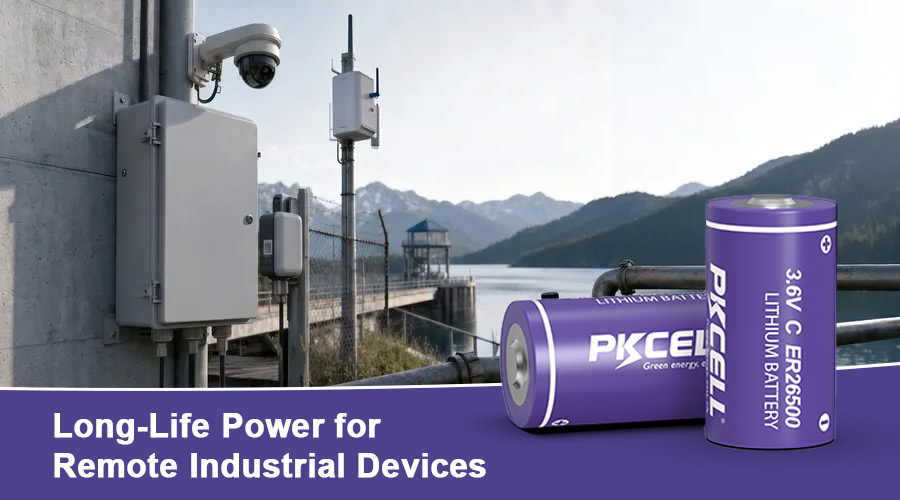
What Is a Primary Battery?
A primary battery is a non-rechargeable battery designed for one-way energy use. In industrial applications, primary batteries are usually selected when devices need long standby time, low self-discharge, stable output, and dependable operation in installations where frequent maintenance is not realistic.
In industrial procurement, the best battery is often the one that reduces truck rolls, labor hours, and field-service risk over the full deployment life.
Why Primary Batteries Still Matter in Industrial Projects
Although rechargeable systems are essential in many applications, primary batteries remain highly relevant in industrial power design. According to the reference content pattern used here, primary lithium solutions are repeatedly positioned for remote and unattended equipment where recharge infrastructure adds complexity or is simply unavailable.
- They simplify device architecture by removing charging circuits and charging management requirements.
- They are well suited for remote deployments where replacement intervals are measured in years rather than weeks.
- They support standby-heavy applications where the device sleeps most of the time and transmits or records only at intervals.
- They can reduce total maintenance cost even when unit cost is higher than general-purpose batteries.
Main Industrial Application Scenarios for Primary Batteries
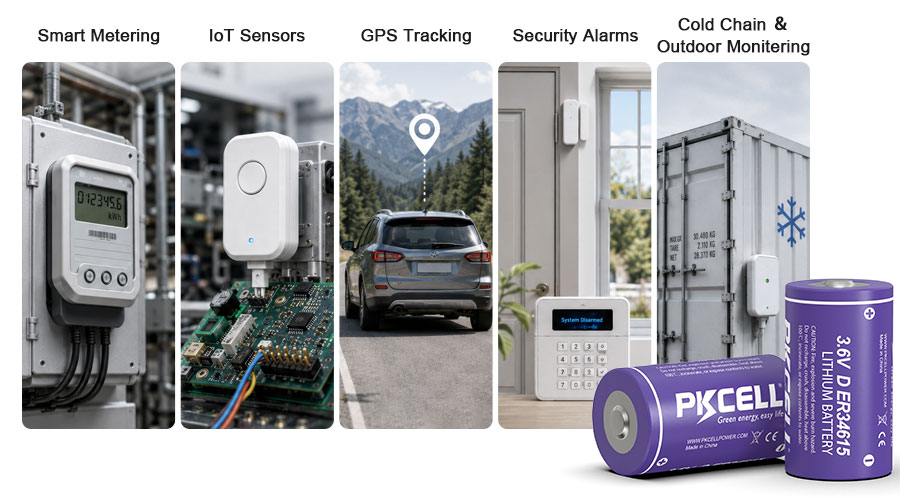
1. Smart Metering
Water, gas, and electricity meters are classic primary battery applications. These devices are expected to remain installed for long periods with minimal service intervention. A battery with low self-discharge and long service life is often more important than rechargeability.
2. Remote IoT Sensors
Environmental monitoring, agricultural sensing, grain storage monitoring, and structural condition monitoring often operate far from convenient power access. In these scenarios, primary lithium batteries are commonly selected because they support long idle periods and predictable replacement planning.
3. GPS and Asset Tracking
Tracking devices usually combine low standby current with short transmission bursts. In this type of design, engineers may use a primary lithium battery architecture and, when needed, pair it with pulse support to handle wireless communication peaks more effectively.
4. Security and Alarm Systems
Security sensors, alarm nodes, and emergency signaling devices depend on high reliability. Many of these products spend most of their life waiting for an event, which makes long-life primary chemistry a logical fit.
5. Cold-Chain and Outdoor Monitoring
Industrial devices deployed in cold storage, logistics monitoring, parking systems, or exposed outdoor environments often need a battery that performs more consistently across demanding conditions. This is one reason primary lithium formats are frequently highlighted in industrial application guides.
Which Primary Battery Chemistries Are Common in Industrial Use?
| Chemistry | Typical Positioning | Common Application Fit |
|---|---|---|
| Alkaline | General-purpose, low-cost disposable option | Basic portable equipment and non-critical short-life uses |
| LiMnO2 | Compact 3V primary option for specialty electronics | Cameras, security devices, compact electronics, key devices |
| LiSOCl2 | Long-life industrial primary lithium chemistry | Smart meters, IoT sensors, trackers, alarms, remote monitoring |
When Is LiSOCl2 the Better Choice?
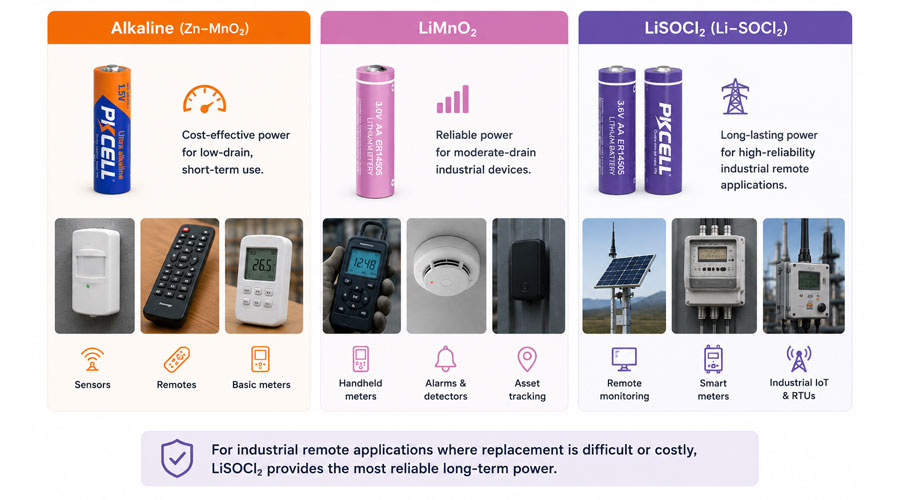 Based on the reference material, LiSOCl2 is consistently framed as a flagship chemistry for unattended industrial deployments. It is especially relevant when the device must deliver long service life, low self-discharge, and dependable standby behavior.
- The device is deployed in the field for multi-year operation.
- The power profile is mostly standby with periodic data transmission.
- Maintenance access is expensive, difficult, or infrequent.
- The project values lifecycle cost more than lowest upfront battery cost.
Primary Battery vs Rechargeable Battery: Which One Fits Better?
For industrial buyers, the real comparison is not disposable versus reusable in the abstract. It is whether the device has a practical charging opportunity, whether the system can tolerate charging hardware, and whether field maintenance economics support a rechargeable design.
- Choose a primary battery when the device is remote, standby-heavy, and expected to run unattended for long periods.
- Choose a rechargeable battery when the device is used frequently, recharged routinely, or draws enough energy that replacement becomes inefficient.
Common Buying Mistakes in Primary Battery Projects
- Selecting by nominal capacity alone without reviewing the full discharge profile.
- Ignoring pulse current demand in wireless devices.
- Using a consumer-style battery choice for an industrial maintenance model.
- Overlooking enclosure size, replacement access, and field labor cost.
FAQ
Can primary batteries be the best option even if the device is used for years?
Yes. In low-power industrial equipment, long operational life often favors a primary lithium solution, especially when regular charging is not realistic.
Are all primary batteries suitable for industrial remote monitoring?
No. General-purpose alkaline batteries may fit simple short-term uses, but long-life remote monitoring often requires a chemistry chosen for industrial standby performance.
What should procurement teams check before sourcing a primary battery?
They should review chemistry fit, expected service life, operating environment, pulse demand, form factor, and long-term supply consistency.
Conclusion
Primary batteries remain a critical power solution for industrial devices that prioritize long service life, low maintenance, and dependable remote operation. For smart metering, IoT sensing, tracking, and security applications, the right primary battery can support both stronger product performance and a more efficient maintenance model.
Need a battery recommendation for your industrial device? Start with the application profile: standby current, pulse load, service interval, environment, and size limits. That is the fastest way to identify whether a primary battery architecture is the right commercial and technical fit.
Post time: May-09-2026


