


Introduction
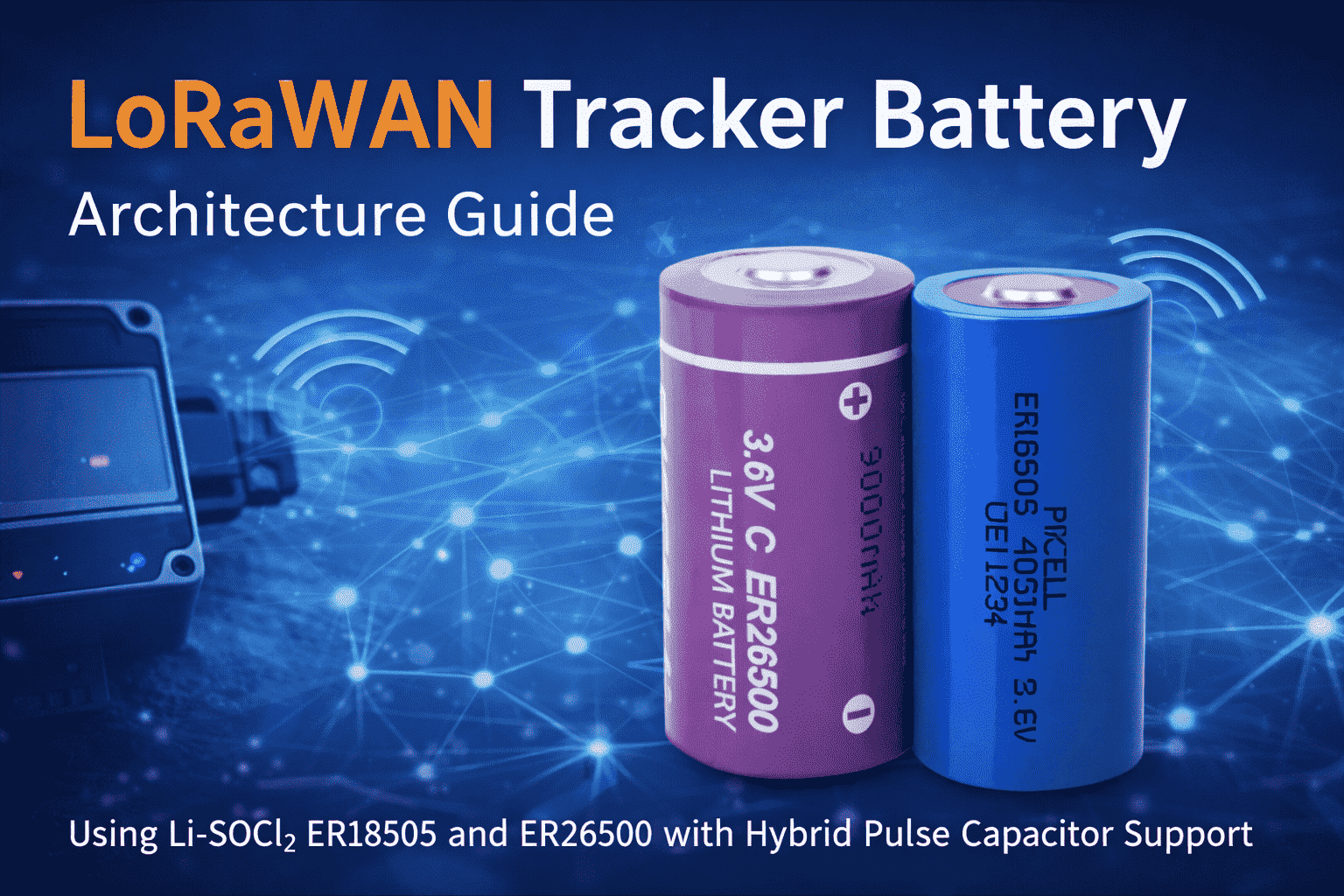
Selecting the right LoRaWAN tracker battery is one of the most critical decisions in low-power IoT hardware design. LoRaWAN trackers are typically deployed in remote environments where maintenance access is limited and battery replacement is costly. Because these devices combine ultra-low standby consumption with periodic high-current transmission bursts, battery selection must consider energy density, pulse capability, temperature stability, enclosure constraints, and deployment lifetime at the same time.
Catalog
1. LiSoCl2 Battery Solutions for LoRaWAN Tracker Applications
2. Why Li-SOCl₂ Batteries Are the Preferred Choice for LoRaWAN Tracker Designs
3. Why Pulse Capacitors Are Used in LoRaWAN Tracker Battery Architectures
4. Typical Power Consumption Profile of a LoRaWAN Tracker
5. Example Battery Lifetime Estimation for a LoRaWAN Tracker
6. Choosing the Right LoRaWAN Tracker Battery for Different Deployment Scenarios
LiSoCl2 Battery Solutions for LoRaWAN Tracker Applications
| Parameter | ER18505 + HPC1550 | ER26500 + HPC1550 |
|---|---|---|
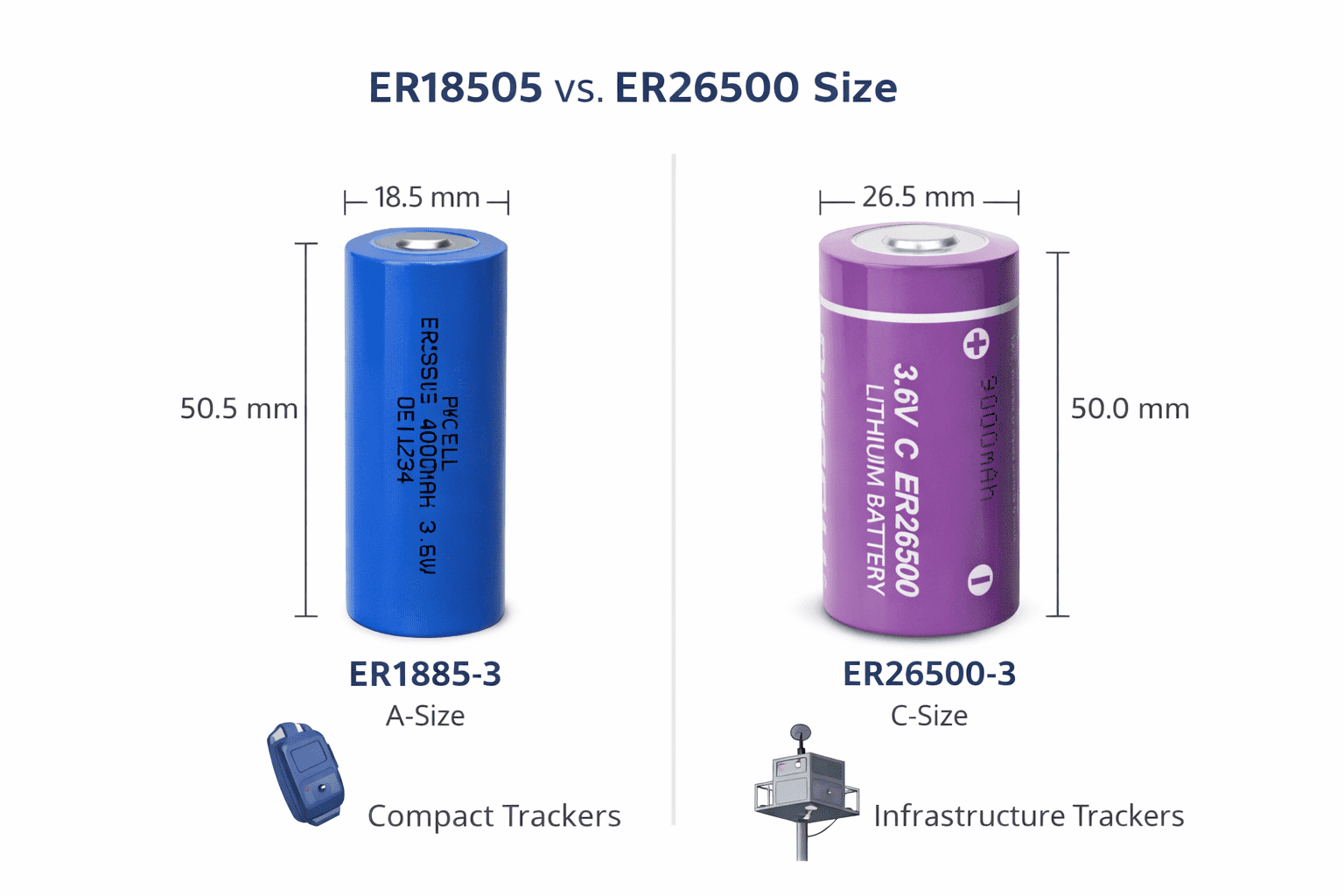
| Cell size | A-size | C-size |
| Typical capacity | ~4 Ah | ~8.5 Ah |
| Typical deployment life | 3–6 years | 5–10 years |
| Device size suitability | Compact trackers | Infrastructure trackers |
| Cold-environment performance | Good | Excellent |
In compact logistics trackers where mechanical space is limited, ER18505 often provides the best balance between size and lifetime. For infrastructure monitoring or remote installations requiring extended service intervals, ER26500 offers a larger energy reserve and stronger temperature resilience.
Download PKCell ER26500 battery datasheet: 规格书
Download PKCell ER18505 battery datasheet: 规格书
Why Li-SOCl₂ Batteries Are the Preferred Choice for LoRaWAN Tracker Designs
Primary lithium thionyl chloride batteries have become the standard chemistry for industrial LoRaWAN trackers because they combine high energy density with extremely low self-discharge.
Key advantages include:
- very low annual self-discharge (typically <1%)
- stable voltage output over long standby intervals
- wide operating temperature range
- high gravimetric energy density
These characteristics allow tracker manufacturers to target 5–10 year deployment lifetimes, which is difficult to achieve using rechargeable lithium-ion or coin cell alternatives.
However, Li-SOCl₂ batteries alone cannot efficiently support repeated RF transmission pulses. This limitation explains the widespread use of hybrid pulse capacitor support.
Why Pulse Capacitors Are Used in LoRaWAN Tracker Battery Architectures
During LoRa transmission, current demand may briefly exceed the optimal pulse capability of a primary lithium thionyl chloride cell. Without buffering, this can cause voltage drop, packet loss, or reduced usable battery capacity.
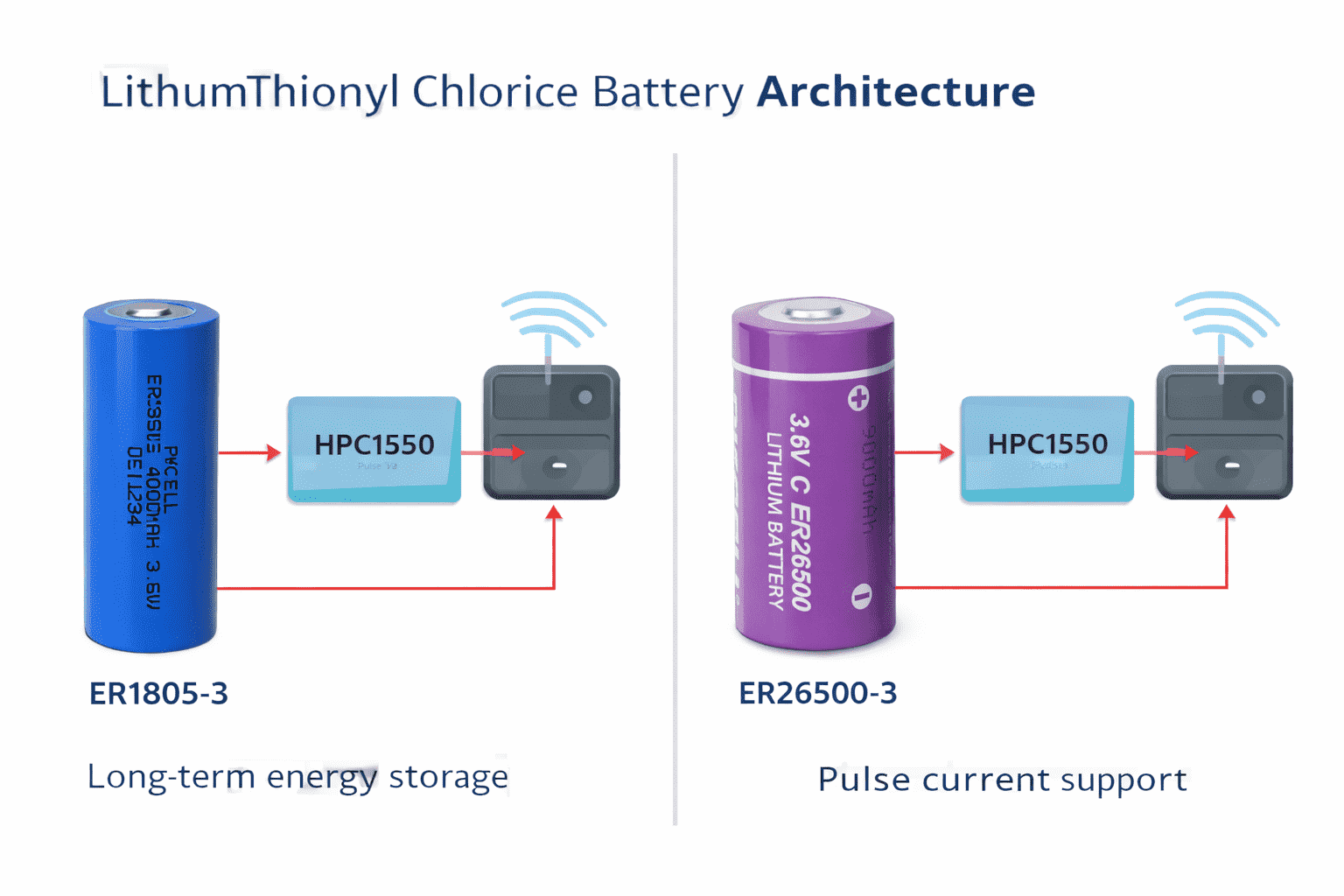
Hybrid pulse capacitors solve this problem by acting as a temporary energy reservoir between the battery and the radio module.
In practical tracker architectures, pulse capacitors provide:
- stable voltage during transmission bursts
- improved RF communication reliability
- deeper usable battery discharge range
- extended overall deployment lifetime
This is why configurations such as ER18505 + HPC1550 and ER26500 + HPC1550 are widely adopted in LoRaWAN tracking devices.
Typical Power Consumption Profile of a LoRaWAN Tracker
A LoRaWAN tracker operates across several power states. Most industrial trackers cycle through three primary operating modes:
- deep sleep mode for standby operation
- GNSS acquisition mode for positioning
- LoRa transmission mode for long-range communication
Typical current consumption values are shown below:
| Operating Mode | Typical Current |
|---|---|
| Sleep mode | 5–20 µA |
| GNSS acquisition | 25–35 mA |
| LoRa uplink transmission | 120–450 mA |
Although transmission events are short, they dominate battery architecture decisions because they create high pulse current demand that many battery chemistries cannot sustain directly.
Example Battery Lifetime Estimation for a LoRaWAN Tracker
Battery lifetime depends on transmission frequency, spreading factor selection, GNSS usage interval, and environmental temperature.
Consider a typical tracker configuration:
- sleep current: 12 µA
- LoRa uplink interval: every 30 minutes
- GNSS positioning interval: once per hour
- transmission duration: ~1.2 seconds
Under these conditions:
| Battery Configuration | Estimated Lifetime |
|---|---|
| ER18505 + HPC1550 | ~4–5 years |
| ER26500 + HPC1550 | ~8–9 years |
Actual lifetime varies depending on retry behavior, network conditions, and operating temperature, but these estimates illustrate the scale of difference between the two architectures.
Choosing the Right LoRaWAN Tracker Battery for Different Deployment Scenarios
Different tracker applications place different priorities on enclosure size, lifetime expectations, and environmental tolerance. Matching the battery configuration to the deployment scenario significantly improves reliability.
Typical selection logic used by tracker designers includes:
Choose ER18505-based configurations when:
- tracker size must remain compact
- transmission frequency is moderate
- deployment duration is under five years
- device weight must be minimized
Choose ER26500-based configurations when:
- tracker must operate for more than five years
- installation location is difficult to access
- device operates in cold environments
- uplink frequency is relatively high
This approach ensures battery architecture aligns with both mechanical and electrical system constraints.
About PKCELL LoRaWAN Tracker Battery Solutions
As an experienced Li-SOCl₂ battery manufacturer, PKCELL provides power solutions specifically optimized for long-life wireless tracking applications where maintenance access is limited and transmission stability is essential.
PKCELL supports tracker manufacturers with integrated configurations based on ER18505 and ER26500 cells combined with hybrid pulse capacitor architectures. As a trusted ER18505 supplier, PKCELL delivers compact battery solutions suitable for asset-tracking devices that require balanced size and multi-year operating life. For infrastructure monitoring platforms requiring extended deployment duration, PKCELL also serves as a reliable ER26500 supplier, offering higher-capacity configurations designed for harsh environments and low-temperature operation.
Post time: Apr-08-2026


