

How Smart Packaging Is Creating New Battery Opportunities
Packaging no longer has to do just one job. In some supply chains, a package, pallet or reusable container can also carry a device that records temperature, identifies an asset or reports its location. When that functionality must operate away from a reader or external power source, the power supply becomes part of the packaging design.
That creates opportunities for battery manufacturers and device developers, but not every smart package needs a battery. The right choice begins with the information the system needs to collect, how that information is retrieved and where the electronics will sit.
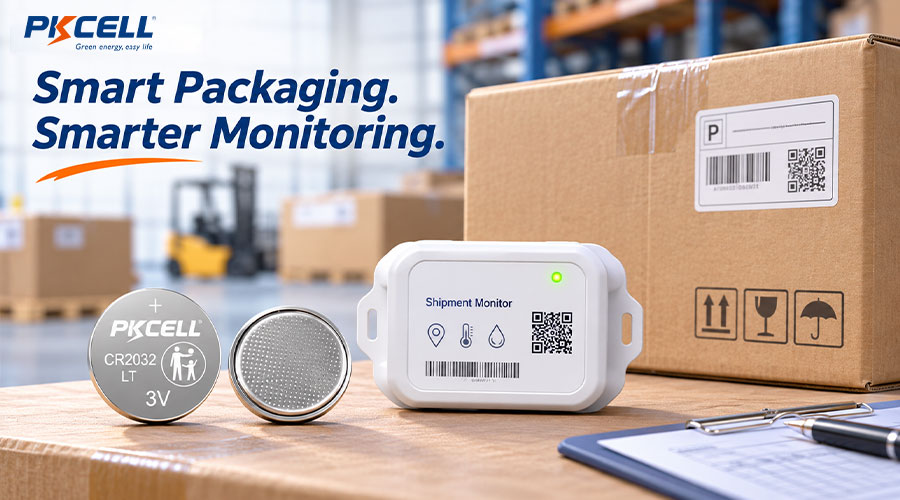
What Is Smart Packaging?
Smart packaging is a broad term for packaging systems that add information or monitoring capabilities to the physical package. The electronic element might be a label, a small module attached to a carton, or a reusable device fitted to a shipping container.
These systems do not all work the same way. A printed code can provide information when scanned, while an electronic device may record conditions or communicate data. The important distinction for battery selection is whether the function must operate independently between reader interactions.
Where Are the New Battery Opportunities?
1. Shipment Condition Monitoring
A battery-powered data logger attached to a package or container can be designed to record conditions such as temperature during transit. For sensitive shipments, the device must operate across storage, transport and the period before the data is retrieved.
PKCELL’s cold-chain monitoring case study describes a customer project in which a battery solution was developed around a container temperature-monitoring device. It illustrates an important distinction: the battery may be housed in a separate monitoring unit rather than embedded in the packaging material itself.
2. Connected Labels and Compact Sensor Modules
Some packaging projects need a compact electronic module that records an event or supports wireless identification. A coin cell may be a candidate when the enclosure has enough room and the electrical load is suitable. The cell, holder and protective structure must fit the complete assembly; a thin label is not automatically thick enough to accommodate them.
PKCELL offers lithium button cells in multiple sizes, including versions with tabs or leads for PCB integration. The exact cell and connection method should be selected against the device drawing and load profile.
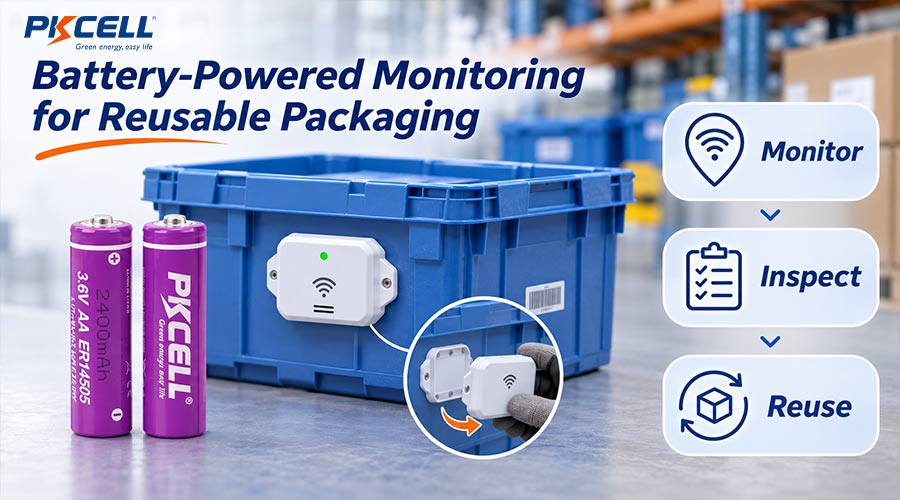
3. Reusable Pallets, Totes and Containers
A reusable transport asset may have more space for electronics than a single-use carton. A removable monitoring module can be evaluated for multiple trips, with the battery chosen around the intended service interval, communication activity and replacement process.
Larger cylindrical cells or custom packs may be practical in these housings. They should not be assumed to fit inside a conventional adhesive label.
4. Tracking and Wireless Reporting
When a logistics device sends wireless updates, the energy budget must include transmission attempts and any retries, not just standby current. PKCELL’s ER + HPC battery pack range provides configurations that can be evaluated for devices combining low-power standby with intermittent pulse demands.
Whether a particular pack is suitable depends on the actual radio waveform, temperature, device cutoff voltage and available space.
Passive or Battery-Powered: Which Architecture Fits?
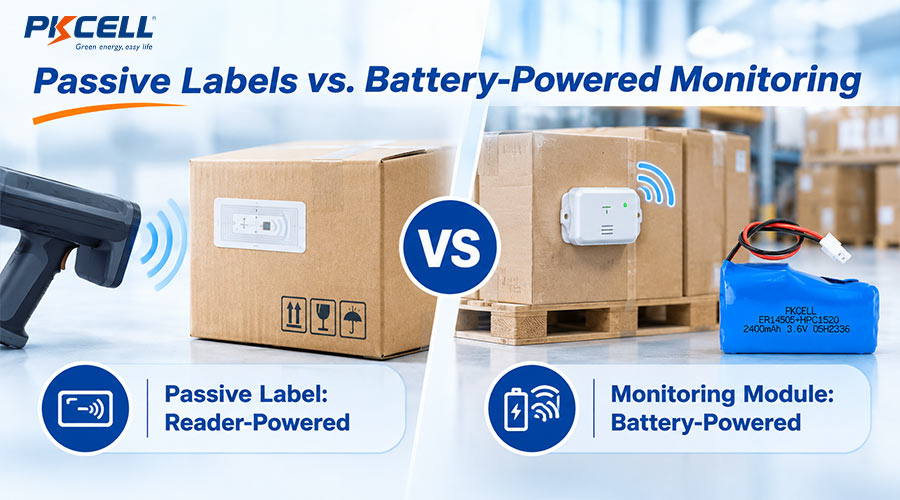
| Approach | How information is used | Power decision |
|---|---|---|
| Printed code | A reader or phone scans information printed on the package. | No battery is needed in the printed code itself. |
| Passive electronic label | A compatible reader powers the label during an interaction. | A label battery may not be needed; confirm the system design. |
| Battery-powered logger | A module records data between retrieval events. | Size the battery for recording, storage, retrieval and the full trip. |
| Connected monitoring module | A device records or reports data using its own electronics. | Account for standby, sensing, communication pulses and retries. |
The most capable option is not always the best commercial choice. If a scan at receiving provides enough information, a passive approach may be simpler. A battery-powered module becomes more attractive when the application needs an independent record or communication between scans.
How to Select a Battery for Smart Packaging Devices
Define the Mission Before Comparing Capacity
Begin with the time from device activation to final data retrieval. Include pre-shipment storage, expected transit, delays and any return trip. A reusable module may need to support several missions before battery replacement, while a single-trip logger has a different design target.
Record how often the device samples, stores data and communicates. For a first estimate, add the charge consumed by each operating state, then include an engineering margin. The result is a planning figure, not a guaranteed runtime.
Check Peak Current as Well as Average Current
A device can use little energy while waiting yet demand a short burst when a radio starts or data is transmitted. The selected battery must keep the voltage above the electronics’ minimum during the real event.
PKCELL’s OEM battery testing guide explains why a voltage reading at rest does not establish performance under load. Test the complete module, including the holder, connections and firmware.
Match the Battery to the Physical Design
Battery thickness, diameter, mounting method and enclosure protection can determine whether a concept is practical. A coin cell may fit a compact housing; a larger cylindrical cell or pack may suit a reusable asset monitor. Neither is automatically suitable for every package.
For projects requiring specific leads, connectors or assemblies, review PKCELL’s custom primary lithium battery pack options and confirm the proposed construction before sampling.
Test the Actual Logistics Environment
Validate the selected battery and finished device under the relevant temperature range, transport handling and storage conditions. For a refrigerated shipment, check performance at the temperature experienced by the battery inside its enclosure, not merely the nominal rating on a product page.
Packaging Lifecycle Decisions Matter Too
Adding electronics changes what happens when the shipment reaches its destination. Before choosing a battery, decide who owns the device, whether it will be retrieved and how the battery and electronics will be handled at end of life.
- Single-trip use: Account for device cost, recovery feasibility and the destination’s disposal requirements.
- Reusable use: Plan return logistics, inspection, data reset and battery replacement.
- Battery access: Define whether replacement is permitted and how the enclosure remains secure.
- Shipment: Confirm applicable transport requirements for the exact cell, pack or finished device.
- Consumer exposure: Assess relevant button-cell safety, enclosure and warning requirements for the destination market.
A removable module can make it easier to separate electronics from packaging, but its actual environmental benefit depends on recovery rates, reuse and the complete system. Avoid making a recycling or sustainability claim without evidence for the intended market.
From Concept to Battery Inquiry: What Should an OEM Prepare?
A useful battery inquiry explains the packaging system as well as the electronics. Share the following information to help a supplier identify practical candidates:
- Application: Package, pallet, tote or container; single-trip or reusable.
- Mission: Storage time, transit duration, activation method and target service interval.
- Electrical profile: Operating and cutoff voltages, standby current, peak current, pulse duration and frequency.
- Environment: Storage and operating temperatures, handling conditions and enclosure requirements.
- Mechanical design: Available dimensions, battery orientation, mounting, terminals and connector details.
- Project scope: Sample quantity, estimated order volume, destination markets and required documentation.
Discuss Your Smart Packaging Battery Project
Developing a shipment logger, connected packaging module or reusable logistics monitor? Share your device requirements with PKCELL to discuss battery options, samples and a project quotation.
Frequently Asked Questions
Does every smart package need a battery?
No. Printed codes and some passive electronic labels work without a battery in the package. A battery may be needed when electronics must record, process or communicate independently.
Can a coin cell power a smart packaging sensor?
A coin cell can be evaluated for a compact, low-power sensor module if its voltage, current capability, dimensions and operating conditions match the design. Verify performance in the finished device.
What is the biggest battery selection mistake?
Choosing from nominal capacity alone. Startup and communication pulses, temperature, voltage cutoff, storage time and mechanical integration can all affect whether the device completes its mission.
Conclusion: Match the Power Source to the Packaging Mission
Smart packaging creates battery opportunities where independent sensing, data storage or communication adds value. Those opportunities range from compact electronics attached to individual shipments to larger monitoring modules used with reusable transport assets.
The best design begins by asking what information is needed, when it must be available and how the device will be managed after delivery. From there, engineers can determine whether a battery is necessary and validate the right cell or pack for the complete system.
Explore PKCELL’s primary lithium battery solutions or contact the team to discuss your application.
Post time: Nov-25-2026


