

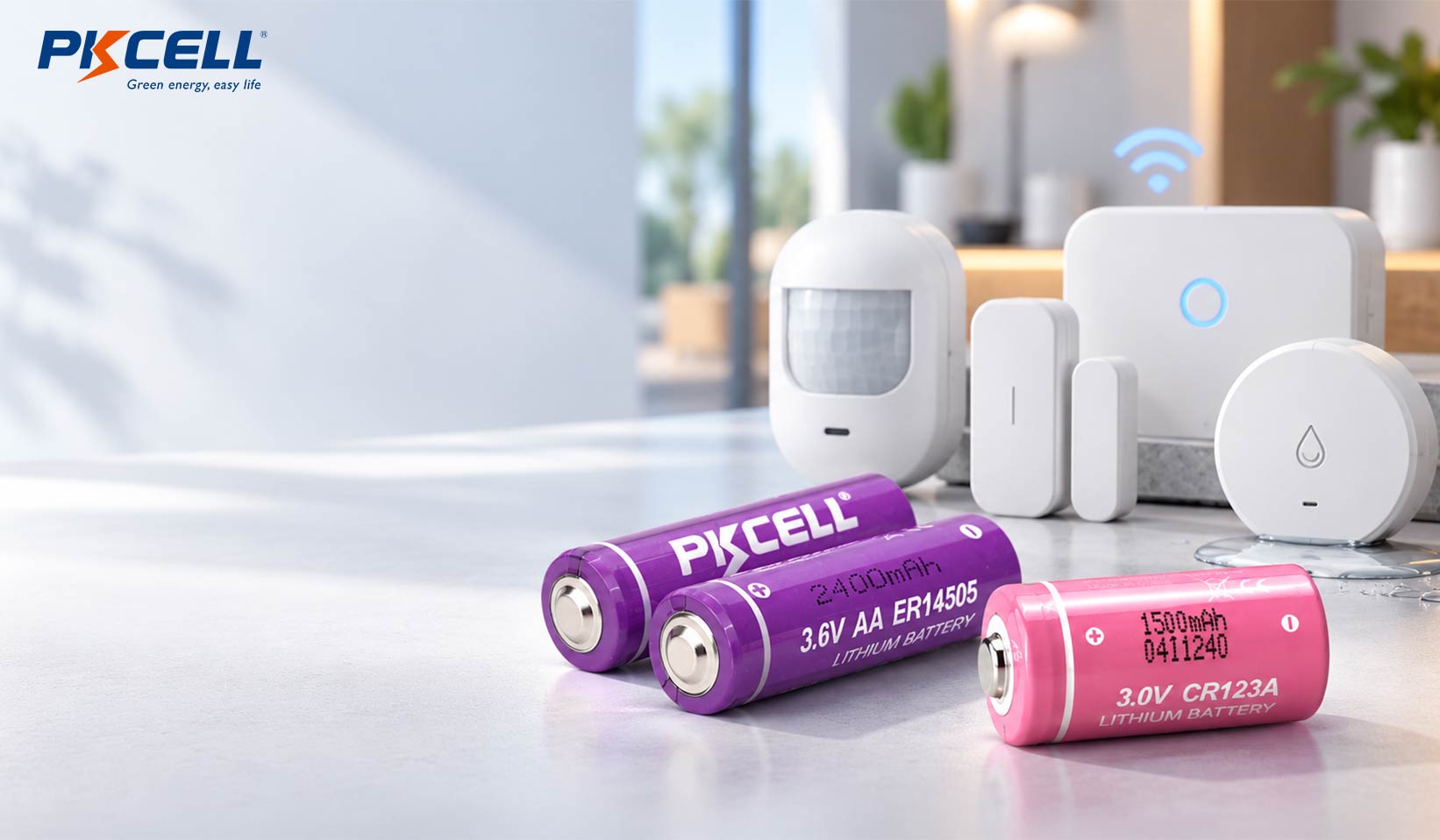
Smart home sensors and wireless devices help monitor homes, detect unusual conditions, and automate everyday functions. From door contacts and motion detectors to water leak alarms and remote monitoring nodes, these devices depend on a reliable power source to remain available when an event occurs.
Battery selection affects more than operating time. It also influences device size, maintenance intervals, wireless communication reliability, and the cost of servicing devices installed throughout a building.
For manufacturers developing battery-powered smart home products, the key is to match the battery to the device’s actual operating pattern. This guide explains how batteries support different smart home functions, where primary lithium batteries may fit, and what OEM teams should evaluate before finalizing a power design.
1. Why Smart Home Sensors Need Reliable Battery Power
Many smart home sensors operate independently of a permanent wired power connection. They may be installed on doors, windows, walls, pipes, utility cabinets, or other locations where running power cables would add complexity.
A battery allows the device to operate without a continuous external power connection. This can simplify installation and provide flexibility when sensors are added to an existing building.
However, a wireless device does not consume the same amount of energy at all times. Its power requirements depend on what it is doing.
Monitoring and Standby
During standby, a sensor may monitor an input, maintain a timer, or keep a low-power controller ready for an event. Some devices remain in a low-power state for most of their operating life.
Even a small standby current accumulates over time. Engineers should measure the complete device’s average current, including its sensing circuit, controller, regulator, and communication hardware.
Event Detection and Reporting
When a door opens, movement is detected, or water reaches a leak sensor, the device may wake its processor and transmit a notification. This event can temporarily increase power consumption.
The battery must therefore support both the energy used over the intended service period and the electrical demands of important operating events.
2. How Batteries Support Different Smart Home Devices
Smart home products have different operating requirements. A battery suitable for an infrequently triggered contact sensor may not be the best choice for a camera or another device that processes and transmits data frequently.
| Device type | Typical power behavior | Battery consideration |
|---|---|---|
| Door and window contact sensors | Low-power monitoring with event-triggered reporting | Standby consumption, service interval, and radio activity |
| Motion detectors and alarms | Monitoring followed by sensing, processing, and transmission | Event frequency, pulse current, and voltage stability |
| Water leak sensors | Periodic or continuous sensing, with an alert when a leak is detected | Installation environment, standby current, and maintenance access |
| Remote environmental sensors | Scheduled measurements and intermittent wireless reporting | Reporting interval, temperature, and target operating life |
| Wireless cameras and video devices | Potentially substantial processing and communication loads | Average power, peak load, and suitability of a rechargeable or wired architecture |
For examples of battery integration in security devices, see the PKCELL wireless detector application. The battery model and configuration must be selected for the actual device specification.
3. Why Primary Lithium Batteries May Suit Selected Wireless Devices
Primary lithium batteries are non-rechargeable batteries designed for single-use discharge. Selected chemistries can be useful in wireless devices that need compact energy storage, low self-discharge, or extended periods between battery replacements.
Li-SOCl2 for Compatible Long-Standby Devices
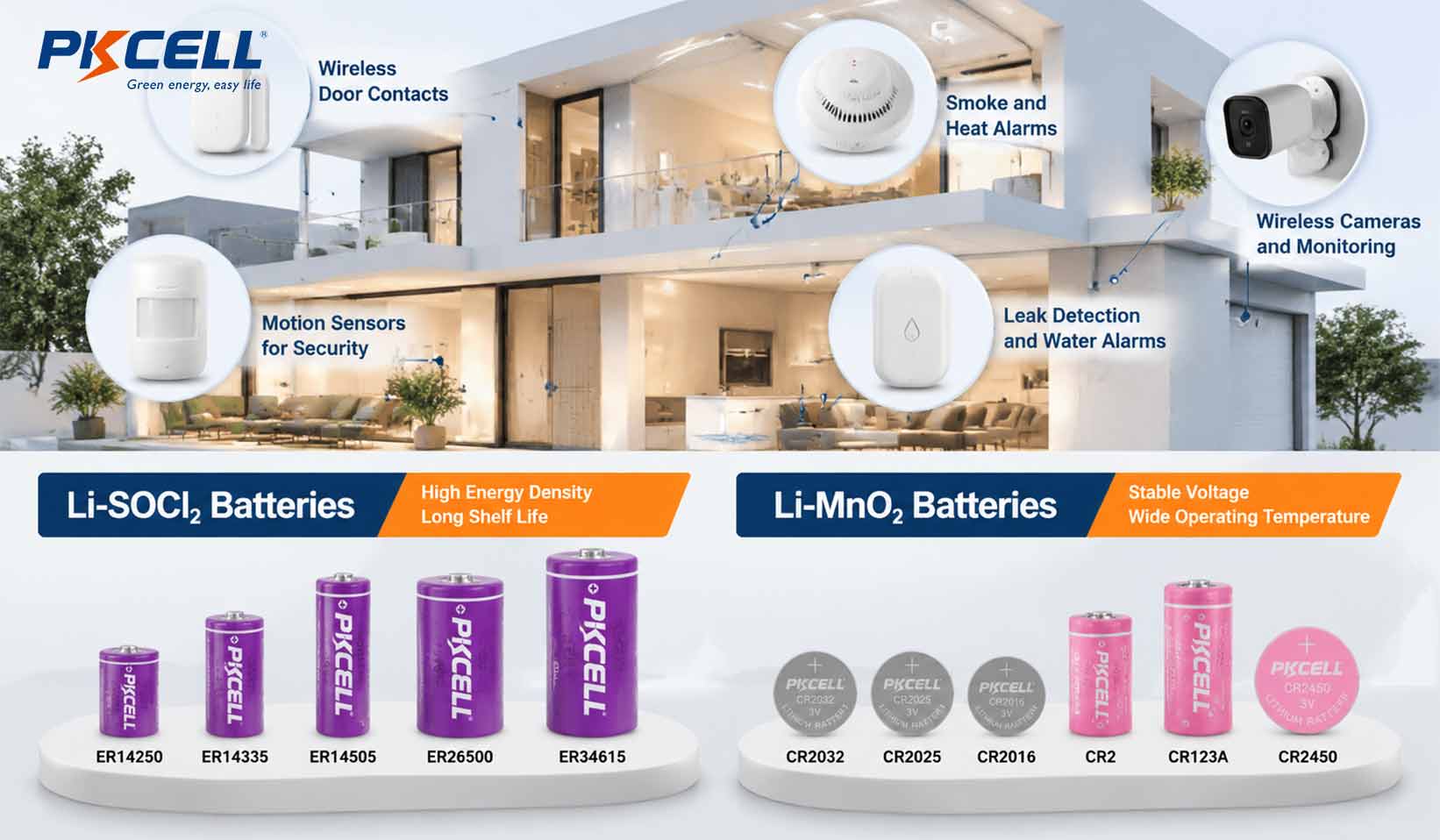
Lithium thionyl chloride (Li-SOCl2) batteries are often evaluated for industrial sensors, remote monitoring equipment, and other devices with low average current and long deployment requirements.
Their low self-discharge characteristics can be useful when devices are expected to remain installed for extended periods. However, some Li-SOCl2 cell constructions are intended primarily for low-current operation. A device with demanding radio pulses may require a different cell design or an appropriately engineered pulse-support solution.
Review the PKCELL Li-SOCl2 battery range for models that may fit compatible applications.
Li-MnO2 for Compatible Compact Electronics
Lithium manganese dioxide (Li-MnO2) primary batteries are available in several formats, including CR-series cylindrical cells. Depending on the design, they may be suitable for compact security electronics and other devices that specify a compatible primary lithium battery.
For example, the PKCELL CR123A 3V Li-MnO2 battery can be evaluated when a device is designed for that format and chemistry.
Do not treat a CR123A and an ER-series cell as interchangeable. Their nominal voltages, physical dimensions, discharge characteristics, and application requirements differ.
When a Rechargeable Battery May Be More Appropriate
Some smart home devices, particularly products with cameras, displays, frequent high-power activity, or built-in charging systems, may be better suited to rechargeable batteries or a wired power supply.
PKCELL Power focuses on primary lithium batteries and related solutions. The appropriate architecture depends on the device’s complete power requirements, not simply on whether the device is described as a smart home product.
For more background, read the primary versus rechargeable lithium battery selection guide.
4. Wireless Communication Changes the Power Requirements
A wireless sensor’s power consumption depends not only on sensing but also on communication. Sending an alert or reporting a measurement may require the radio to wake up, connect to a network, transmit data, and wait for a response.
Different wireless technologies and network conditions create different operating profiles. Engineers should evaluate the actual hardware and communication settings rather than assume that every wireless sensor has the same battery demand.
Communication Frequency
A sensor that reports infrequently may have a different energy budget from one that sends updates every few minutes. More frequent reporting can increase total energy consumption even when each transmission is short.
Network Retries and Poor Coverage
Weak signal conditions may lead to longer communication sessions or repeated attempts. These events can increase energy use and may cause voltage drops if the battery cannot support the required load.
Device Wake-Up and Processing
Power consumption may also rise when the device wakes its processor, reads a sensor, performs calculations, and activates the radio. These activities should be included in the overall power budget.
For OEM designs, measuring the actual operating sequence is more useful than estimating battery life from a nominal radio current alone.
5. Environmental Conditions and Maintenance Planning
Smart home sensors may be installed in indoor rooms, garages, basements, utility cabinets, or semi-outdoor areas. The installation environment affects battery selection and maintenance planning.
Temperature
Battery performance varies with temperature and discharge conditions. Engineers should consult the exact product specification and evaluate available capacity and loaded voltage across the intended operating range.
Installation and Replacement Access
A sensor mounted in an easily accessible room may be simple to service. A detector installed in a ceiling void, external enclosure, or difficult-to-reach location can involve additional labour when its battery needs replacement.
When planning service intervals, consider the complete device’s energy consumption, expected event frequency, self-discharge, temperature, and the manufacturer’s recommended replacement procedure.
Storage Before Installation
Some devices may remain in warehouses or distribution channels before installation. Battery shelf life and storage conditions should be included in product planning, especially when the battery is installed during manufacturing rather than at the final installation site.
6. Integrating the Battery into an OEM Smart Home Product
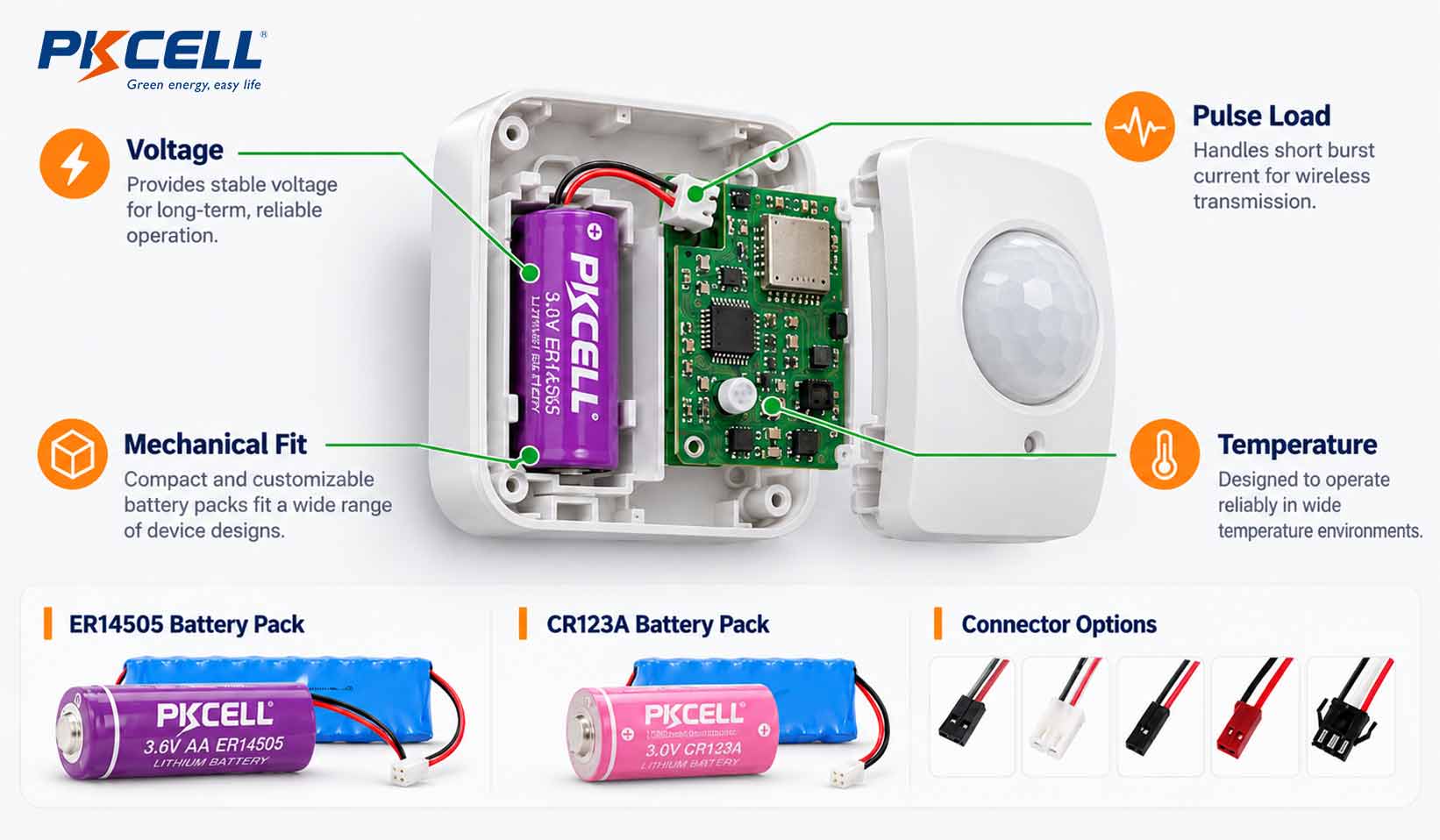
Battery integration requires more than selecting a cell with an appropriate nominal capacity. The battery must fit the enclosure, meet the electrical requirements, and connect reliably to the device.
Before finalizing a design, confirm the following:
- Required nominal voltage and permitted operating voltage range.
- Standby current and energy consumed during each operating event.
- Peak current, pulse duration, and repetition frequency.
- Cell dimensions, battery holder, terminal style, and polarity.
- Wire length, connector type, and installation constraints.
- Operating temperature and expected service interval.
- Relevant product documentation and transport requirements.
For projects requiring a tailored primary battery assembly, review PKCELL customized primary lithium battery pack solutions. Configuration and suitability must be confirmed against the actual project requirements.
7. What Smart Home Device Manufacturers Should Validate
Before releasing a battery-powered device, manufacturers should verify that the selected battery works with the complete electronic system under representative conditions.
- Measure standby current with the complete device assembled.
- Record current consumption during sensing, processing, and wireless reporting.
- Check voltage during the highest expected load.
- Test performance at relevant operating temperatures.
- Verify the expected service interval using realistic usage assumptions.
- Check battery fit, connector compatibility, and installation method.
- Document the approved battery model and validation criteria.
These steps help identify whether a standard primary lithium cell or a customized battery assembly is suitable for the intended product.
Frequently Asked Questions
What batteries are used in smart home sensors?
Depending on the device design, smart home sensors may use primary lithium batteries, alkaline batteries, rechargeable cells, or a wired power supply. The correct choice depends on voltage, energy consumption, communication frequency, installation conditions, and the manufacturer’s specification.
Why do some wireless sensors use primary lithium batteries?
Selected primary lithium batteries offer low self-discharge and useful energy storage for compatible devices that spend long periods in standby. The cell must still support the device’s required voltage and current profile.
Can one battery type power every smart home device?
No. Door contacts, motion detectors, leak sensors, cameras, and wireless gateways can have very different power requirements. Battery chemistry, dimensions, voltage, and discharge capability must be matched to the device.
How does wireless communication affect battery life?
Communication frequency, transmission duration, network retries, and processor wake-up activity all contribute to energy consumption. Actual operating measurements provide a better basis for estimating battery life than a single nominal current figure.
Can PKCELL support OEM battery requirements for wireless sensors?
PKCELL can review applications compatible with its primary lithium battery portfolio. Share the voltage, standby current, peak load, reporting frequency, operating temperature, available space, and expected service interval for an initial assessment.
Conclusion
Batteries support smart home sensors and wireless devices by providing power for continuous monitoring, event detection, processing, and wireless communication. The best battery architecture depends on the device’s actual operating pattern, not simply its product category.
Primary lithium batteries can be suitable for compatible sensors and wireless devices that prioritize low self-discharge and long periods between battery replacements. Products with sustained high power demand or frequent charging requirements may need a different architecture.
For manufacturers, the most reliable approach is to evaluate the complete device, verify electrical and mechanical compatibility, and validate the selected battery under realistic operating conditions.
Looking for a Battery for Your Smart Home Device?
Tell PKCELL about your device voltage, standby current, wireless reporting frequency, peak load, operating temperature, installation space, and target service interval. Our team can review the requirements and discuss suitable primary lithium battery options.
Explore our Li-SOCl2 batteries, Li-MnO2 batteries, and primary lithium battery packs.
Post time: Oct-27-2026


