

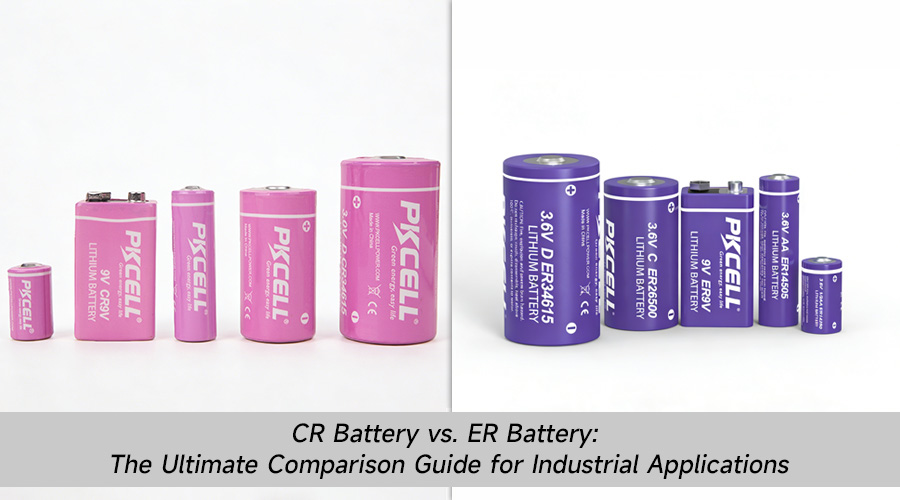
Key Facts
- A LiMnO2 battery (CR) typically provides 3.0V, whereas a li socl2 3.6 v battery (ER) offers a higher nominal voltage for energy-intensive electronics.
- LiSoCl2 chemistry possesses the highest energy density of any mass-produced primary battery, making it the “gold standard” for long-term industrial use.
- LiSoCl2 battery cells feature an incredibly low self-discharge rate of less than 1% per year, allowing for a shelf life of up to 15 years.
- CR batteries are better suited for high-pulse applications, while standard ER batteries may experience “passivation” if not used with a capacitor.
Introduction
When you are designing a smart meter or a high-end medical device, the battery choice dictates the product’s lifespan. You need a solution that balances cost, safety, and longevity. This guide breaks down the technical nuances between the LiMnO2 battery and the LiSoCl2 battery to ensure your project stays powered for years to come.
Understanding the Chemistry: CR vs. ER
The primary difference lies in the cathode material and the resulting voltage.
What is a CR Battery (LiMnO2)?
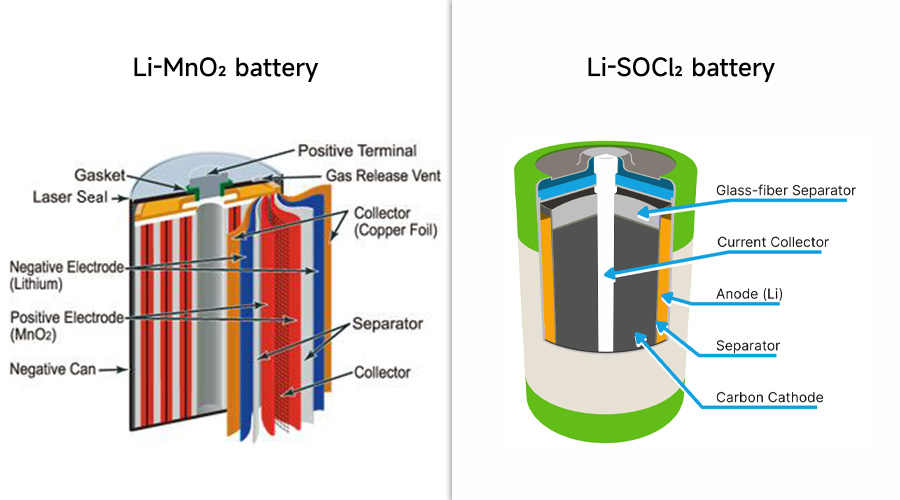
The LiMnO2 battery uses a solid manganese dioxide cathode. It is known for its stability and ability to provide relatively high pulse currents without significant voltage drops. At a nominal 3.0V, these batteries are common in both consumer and industrial sectors. You’ve likely seen them in the form of CR123A or CR2032 cells.
What is an ER Battery (LiSOCl2)?
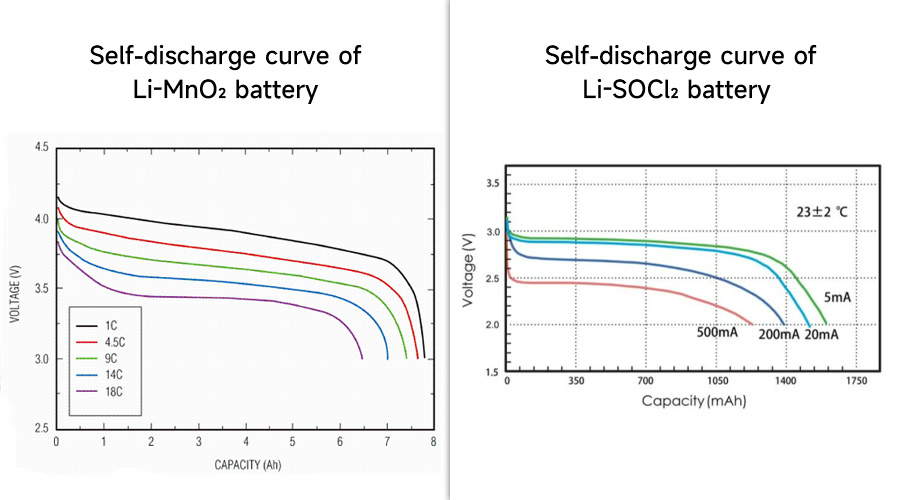
The LiSoCl2 battery uses a liquid thionyl chloride cathode. This allows for a much higher energy density—nearly double that of alkaline batteries. It maintains a very flat discharge curve. This means the device receives consistent 3.6V power until the very end of the battery’s life.
Technical Head-to-Head Comparison
To help you decide, we have compiled the essential specs for PKCELL’s leading lithium products.
|
Battery Voltage
|
LiMnO2: 3.0V
|
LiSoCl2: 3.6V
|
|
Energy Density
|
Moderate |
Very High
|
|
Self-Discharge
|
~1-2% per year |
< 1% per year
|
|
Operating Temp
|
-40°C to +70°C | -60°C to +85°C |
|
Service Life
|
5-10 Years | 10-15+ Years |
|
Best For
|
High pulse, consumer gear | Low-drain, long-term industrial |
When to Use Which? Performance Deep-Dive
The Case for CR (LiMnO2)
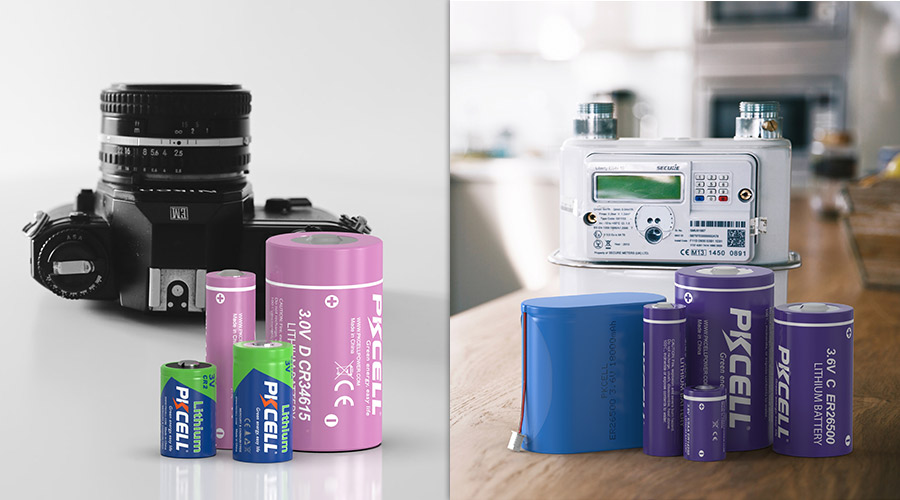
If your device requires frequent high-current bursts—think of a camera flash or a medical AED—the LiMnO2 battery is your best bet. It does not suffer from the “passivation” effect. Passivation is a thin film that grows on the anode of lithium batteries to prevent self-discharge. While useful, it can cause a temporary voltage delay in high-drain situations. CR batteries handle these pulses gracefully.
The Case for ER (LiSOCl2)
For “install and forget” applications, LiSoCl2 is unbeatable. Smart water meters, gas meters, and GPS tracking tags often sit idle for months, waking up only to send a small burst of data. The extremely low self-discharge of the LiSoCl2 battery ensures that power is saved for the work, not lost to the air.
Solving the Passivation Challenge: PKCELL’s HPC Solution
A common concern with the Li-SOCl2 3.6 V battery is the initial voltage drop due to the passivation layer after long-term storage. To solve this for our industrial clients, PKCELL offers the Hybrid Pulse Capacitor (HPC). By pairing a high-capacity LiSoCl2 cell with an HPC, we provide the best of both worlds: the massive energy storage of ER and the high-pulse capability of CR.
Why Partner with PKCELL?
Choosing a manufacturer is as important as choosing the chemistry. Shenzhen PKCELL Battery Co., Ltd. has been at the forefront of battery innovation since 1998.
- Global Reach: We export 70% of our products to Europe, North America, and Southeast Asia.
- Certified Quality: Our factory is ISO9001 certified, and our lithium products carry UL1642, UN38.3, CE, and IEC60086-4 certifications.
- R&D Excellence: With over 30 technical experts and 20+ automated lines, we can customize battery packs to meet your specific voltage and capacity needs.
FAQs
Q: Can I replace a 3V CR battery with a 3.6V ER battery?
A: Usually, no. The 0.6V difference can damage sensitive electronics not designed for the higher voltage of a 3.6V battery. Always check your circuit’s maximum input voltage first.
Q: How do I store ER batteries to minimize passivation?
A: Store LiSoCl2 batteries in a cool, dry place. PKCELL recommends storage below 30°C to maintain the lowest self-discharge rates and ensure a shelf life of over 10 years.
Q: Does PKCELL provide custom battery packs?
A: Yes! We specialize in industrial matching. Whether you need a simple 2S1P configuration or a complex multi-cell pack with a custom BMS, our engineering team can design it.
Post time: Jan-07-2026


