

Battery Selection for Pipeline Corrosion Monitoring Sensors
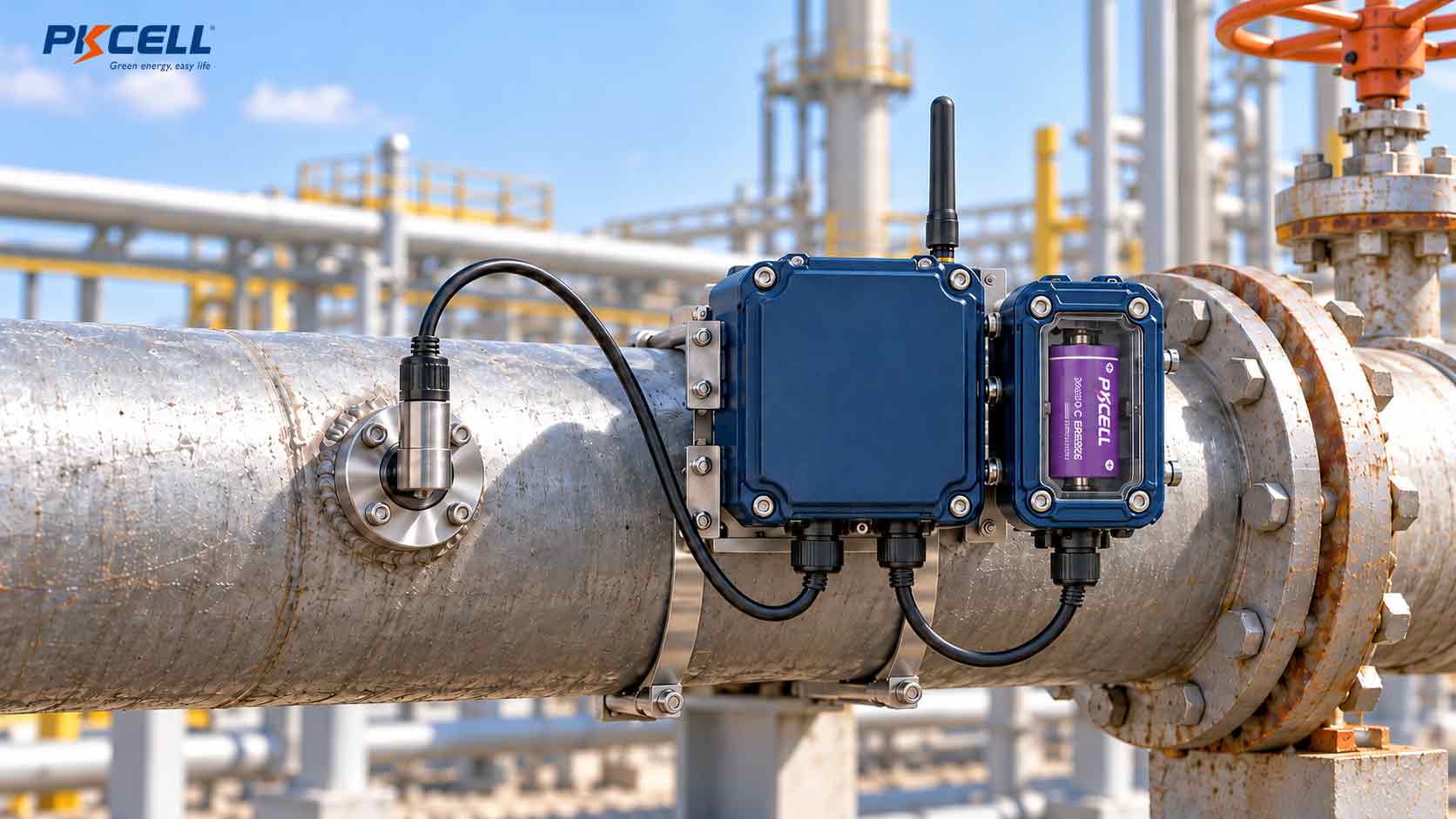
A pipeline corrosion monitoring battery must support more than a sensor’s nominal operating current. A remote monitoring node may collect electrochemical measurements at scheduled intervals, process readings locally, store historical data and transmit results to a supervisory system—all while remaining in the field for extended periods without battery replacement.
For pipeline integrity equipment manufacturers and industrial sensor OEMs, the selection challenge is to balance measurement frequency, standby consumption, wireless transmission, environmental conditions and the cost of accessing remote installations. The best starting point is the complete monitoring workflow, not the battery capacity rating alone.
1. Battery-Powered Pipeline Corrosion Monitoring Applications
Corrosion monitoring helps operators evaluate material degradation and assess the condition of pipelines, storage facilities and related infrastructure. Depending on the monitoring method, a system may measure electrochemical parameters, probe resistance, corrosion trends, pipe-to-soil potential or other indicators used by the integrity management program.
Not every corrosion monitoring system has the same electrical requirements. A low-power remote logger may collect a reading every few hours, while a more sophisticated node may perform frequent measurements, run signal-conditioning electronics and upload results over a cellular or low-power wide-area network.
Typical Battery-Powered Monitoring Configurations
- Remote corrosion data loggers: Record measurements locally and periodically send accumulated data to a remote platform.
- Electrochemical monitoring nodes: Operate sensor interfaces and measurement circuits that may require controlled timing, stable voltage or a defined measurement sequence.
- Cathodic protection monitoring devices: Collect pipe-to-soil potential, current-related measurements or other project-specific parameters used to assess protection performance.
- Wireless pipeline sensor stations: Combine sensing, local processing, memory and a radio module for remote reporting.
A cathodic protection monitoring battery must be evaluated against the electrical design of the monitoring instrument. For example, a system that measures an external potential may have different requirements from a device that actively controls current or powers a measurement excitation circuit. The latter may require a separate power architecture rather than a simple low-power primary cell.
PKCELL’s existing Oil & Gas Battery Solutions page provides the broader application context for harsh and remote industrial installations. This article focuses specifically on the power budget and operating sequence of corrosion monitoring nodes.
2. Continuous Measurement vs. Periodic Measurement
Measurement strategy is one of the first factors to resolve when selecting a pipeline corrosion monitoring battery. Two systems using similar sensors can have very different energy requirements if one measures continuously and the other wakes up periodically.
Continuous Measurement
Continuous monitoring can require the measurement front end, reference circuitry, signal conditioning or data processing components to remain active for extended periods. The total current depends on which circuits stay powered, the measurement technique and whether data is processed locally or transmitted immediately.
Before choosing a primary lithium cell, determine whether continuous operation is genuinely required. If the application permits event-driven or periodic sampling, carefully designed duty cycling may reduce the average load. Measurement accuracy and response-time requirements must remain the priority.
Periodic Measurement
In a periodic architecture, the node can sleep between measurement windows. A typical sequence may include waking the controller, stabilizing the measurement circuit, acquiring readings, applying quality checks, saving the result and returning to sleep.
The energy budget must include the entire sequence, not just the time during which the sensor takes a reading. Reference stabilization, analog settling, processor activity and data storage can extend the active period.
| Operating approach | Primary energy consideration | Battery selection question |
|---|---|---|
| Continuous monitoring | Persistent measurement and signal-conditioning load | Can the battery support the sustained current over the required deployment period? |
| Periodic sampling | Standby consumption plus recurring measurement windows | How much energy does each complete measurement cycle consume? |
| Event-triggered measurement | Sleep current plus unpredictable bursts of activity | Can the battery support the longest credible event and subsequent reporting? |
| Batch telemetry | Stored readings followed by a communication session | Can the battery maintain the required voltage throughout the transmission and retry sequence? |
3. Standby Current, Measurement Loads and Wireless Transmission
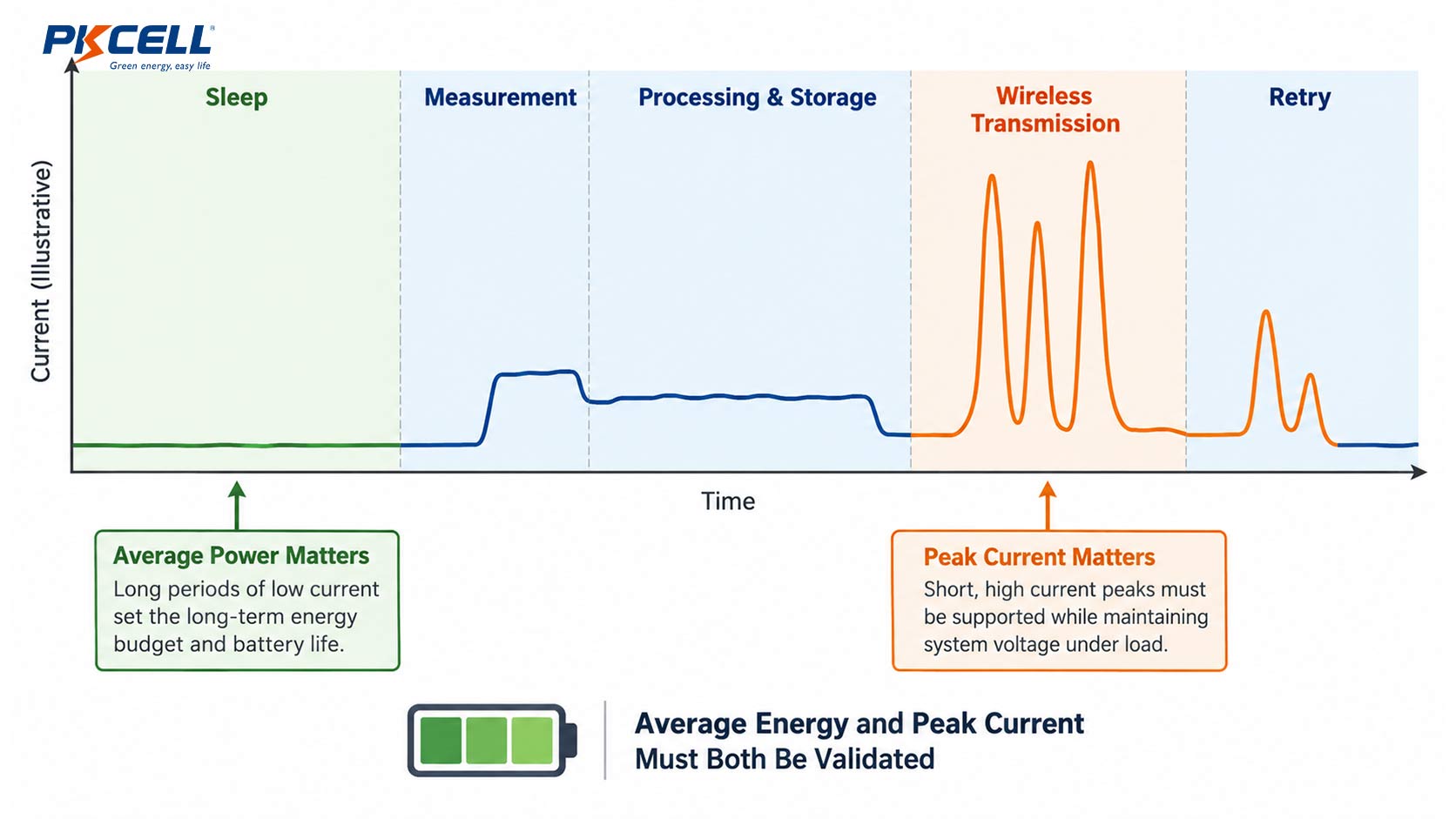
A remote pipeline sensor battery must support the complete operating cycle: standby, measurement, processing, storage, transmission and any required communication retries. Each state contributes differently to total energy consumption and minimum loaded voltage.
Build an Energy Budget from Measured Operating States
Record the current and duration of each state using the actual electronics and firmware wherever possible. Include the measurement circuit’s settling time, sensor excitation if applicable, memory writes, radio startup, network registration and unsuccessful transmission attempts.
For repeated operating cycles, multiply the measured cycle energy by the expected number of cycles over the deployment period. Add separately measured or estimated background consumption, including standby current and any always-on monitoring circuits.
If current varies substantially within a state, use the measured current waveform rather than treating a short peak as a constant load for the entire state duration.
Why Wireless Transmission Can Determine Battery Architecture
A sensor may use little energy while sleeping but demand much higher current when a modem starts, registers with a network or transmits data. Poor coverage can extend the communication window and trigger retries. These events can increase energy consumption while also creating voltage dips that are not visible in an average-current calculation.
Check both the total energy required for reporting and the minimum voltage during the highest credible current pulse. The latter depends on cell construction, temperature, internal impedance, wiring, connector resistance and the device’s voltage cutoff.
This relationship is useful for initial screening, but it does not replace dynamic testing. Lithium thionyl chloride (Li-SOCl₂) cells can exhibit voltage delay after long periods of low-current storage because of passivation. The actual behavior depends on the cell and load conditions.
When to Consider an ER + HPC Configuration
For a monitoring node that combines long standby periods with short, demanding communication pulses, an ER + Hybrid Pulse Capacitor (HPC) configuration may be worth evaluating. The ER cell provides the main energy reserve, while the HPC supports transient power demands.
Review PKCELL’s IoT Battery Pack (ER + HPC) options when the measured radio load exceeds what the selected energy-oriented cell can reliably deliver. The final design must account for HPC leakage, recharge time, pulse repetition, temperature and the complete device load.
4. Temperature, Enclosure and Deployment Constraints
Pipeline monitoring equipment can be installed in roadside cabinets, remote valve stations, buried utility enclosures, exposed field locations or specialized industrial environments. The battery’s operating conditions therefore need to be defined for the actual installation, rather than inferred from the general label “oil and gas.”
Evaluate the Complete Temperature Profile
Document the minimum and maximum temperatures the battery will experience, including storage, transportation, installation and normal operation. An enclosure exposed to direct sunlight may reach a higher internal temperature than the surrounding air.
At low temperatures, battery impedance and available output under load can change. At elevated temperatures, aging and self-discharge behavior may change. The usable capacity and pulse capability must therefore be evaluated at the specified operating conditions.
Distinguish Corrosion Resistance of the Enclosure from Battery Performance
A corrosion-resistant enclosure does not automatically make the battery assembly suitable for the same environment. The design must account for moisture ingress, condensation, cable glands, connector sealing, chemical exposure, vibration and maintenance access.
Battery selection and enclosure engineering should be reviewed together. Confirm the mechanical envelope, mounting arrangement, insulation, connector materials and cable routing against the installation requirements.
Account for Hazardous-Area and Project-Specific Requirements
Some pipeline installations may be subject to hazardous-area requirements or other project-specific safety rules. The suitability of a battery-powered instrument depends on the complete equipment design, applicable approvals and installation conditions. A cell certification alone does not establish that the finished device is approved for a hazardous location.
PKCELL’s Oil & Gas solution page provides additional context on the demanding environments encountered in remote industrial applications.
5. Battery Chemistry and Configuration for Corrosion Monitoring
Selecting an oil and gas corrosion sensor battery starts with the current profile, service-life target, voltage requirements and environmental conditions. Li-SOCl₂ is a relevant primary-battery option for many low-power industrial monitoring applications, but the correct cell construction and configuration depend on the device.
| Battery option | Potential fit | What engineers must verify |
|---|---|---|
| ER energy-type Li-SOCl₂ cell | Low average current and long intervals between service visits | Required energy, temperature derating, self-discharge, pulse voltage and end-of-life performance |
| ER power-type Li-SOCl₂ cell | Applications needing greater discharge capability than an energy-oriented cell can provide | Capacity trade-off, continuous load, pulse waveform and actual operating temperature |
| ER + HPC pack | Long standby with short, high-current wireless reporting events | Peak current, pulse duration, event repetition, recharge interval and HPC leakage |
| Custom primary lithium battery pack | Special voltage, space, wiring, connector or installation requirements | Cell arrangement, pack dimensions, electrical limits, environmental integration and validation |
Choosing an ER Cell Size
PKCELL’s ER energy-type Li-SOCl₂ battery range includes models such as ER14505, ER18505, ER26500 and ER34615. For example, the listed ER18505 has a nominal voltage of 3.6 V and a rated capacity of 4000 mAh, while the listed ER34615 has a nominal voltage of 3.6 V and a rated capacity of 19000 mAh.
These ratings provide a starting point for comparison, not a direct prediction of field runtime. Actual usable capacity depends on discharge conditions, temperature, cutoff voltage, storage history and the selected cell specification.
A larger cell may extend the energy budget, but it also changes the dimensions, mass and mounting requirements. Where space is limited, an alternative cell or a customized pack may provide a better integration path.
When a Custom Battery Pack Makes More Sense
A finished pack can simplify integration when the sensor requires a particular lead length, connector, mounting arrangement or multi-cell configuration. Pack design should be based on the electrical and mechanical requirements of the finished instrument, not only on the availability of a standard cell.
Explore PKCELL’s customized primary lithium battery packs for project-specific primary lithium configurations, including ER-series cells and ER + HPC options. Provide the required voltage, load profile, dimensions, cable and connector details when requesting an engineering review.
6. Battery Life Estimation and Field Validation Checklist
A useful runtime estimate begins with measured operating states and ends with validation in the actual device. For a remote pipeline sensor battery, the design should reserve sufficient energy for the intended deployment period and confirm that the system can still complete its required measurement and reporting sequence near end of life.
Step 1: Calculate the Energy Budget
Calculate the energy consumed by each measurement cycle and communication event. Include standby consumption, self-discharge, scheduled reporting, event-triggered activity and expected retries. Use measured values where available, and clearly identify any estimates that still require testing.
This simplified estimate is suitable for initial screening only. It assumes that usable energy has already been adjusted for the relevant operating conditions and that the system can maintain its required voltage throughout the deployment.
Step 2: Apply Practical Design Allowances
Do not treat nominal capacity as fully usable energy. Consider temperature effects, self-discharge, production variation, aging, cutoff voltage, pulse-related limitations and a reserve for abnormal operating conditions. Avoid assigning a universal derating percentage without evidence from the specific cell and application.
Step 3: Validate the Complete Measurement and Reporting Cycle
- Measure sleep current over a representative period, including always-on circuits and periodic wake-ups.
- Record the full measurement sequence, including sensor settling, signal conditioning, processing and data storage.
- Measure wireless startup and transmission at the battery terminals, including network registration and credible retry scenarios.
- Test at the specified minimum and maximum battery operating temperatures after the device has stabilized.
- Evaluate voltage recovery and startup behavior after extended low-current storage, particularly for Li-SOCl₂ applications.
- Repeat critical tests using batteries representative of the intended end-of-life condition.
- Confirm connector retention, cable resistance, enclosure sealing and mechanical integration.
- Compare the measured energy budget against the required field maintenance interval and documented reserve.
For a broader view of primary lithium options, visit the PKCELL Primary Lithium Battery Solution Hub to compare application-specific solution directions before finalizing a cell or pack specification.
7. Common Battery Selection Mistakes
- Choosing a cell based on rated capacity without calculating measurement-cycle energy.
- Ignoring sensor excitation or analog-circuit settling time.
- Treating radio startup and network retries as negligible loads.
- Assuming that a battery’s published temperature range guarantees complete-device performance at those temperatures.
- Ignoring self-discharge and the battery’s storage history.
- Setting a maintenance interval from an ideal runtime estimate without a reserve.
- Overlooking connector resistance, cable routing and enclosure constraints.
- Assuming that a battery cell alone certifies the complete device for use in a hazardous area.
Frequently Asked Questions
What is a suitable battery for a remote pipeline corrosion sensor?
The answer depends on measurement frequency, standby current, reporting behavior, required voltage, temperature and service-life target. ER-series Li-SOCl₂ cells are a relevant starting point for many low-power primary-battery applications. Devices with demanding radio pulses may need a power-oriented cell or an ER + HPC pack. The final choice should be verified in the complete device.
How does measurement frequency affect battery life?
More frequent measurements generally increase energy consumption when each measurement activates the sensor interface, processor or storage circuitry. The actual impact depends on the duration and current of each state, so the complete measurement cycle should be measured rather than estimating from sampling frequency alone.
Can Li-SOCl₂ batteries support wireless corrosion monitoring?
They can be suitable for some wireless monitoring designs, especially those with long standby periods and low average consumption. However, the cell’s pulse capability, passivation behavior, temperature performance and the radio’s minimum voltage requirement must be evaluated. A pulse-assisted configuration may be appropriate for some devices.
What information is needed for a custom pipeline sensor battery pack?
Provide the voltage range, standby and peak current, measurement schedule, transmission profile, temperature range, target deployment period, maximum dimensions, cable and connector requirements, applicable project approvals and estimated order quantity. These details help establish a realistic engineering starting point.
Match the Battery to Your Pipeline Monitoring Workflow
A dependable pipeline corrosion monitoring battery must support the actual measurement strategy, maintain the required voltage during data acquisition and transmission, and provide sufficient usable energy for the intended maintenance interval.
By measuring each operating state, validating communication loads and accounting for the installation environment, equipment manufacturers can make more defensible battery selections and reduce the risk of premature field replacement.
PKCELL supports primary lithium cell and customized battery-pack requirements for industrial monitoring applications. The appropriate solution depends on the project’s electrical, mechanical and environmental specifications.
Request a Battery Recommendation for Your Pipeline Sensor
Developing a corrosion monitoring logger, cathodic protection monitoring instrument or remote pipeline telemetry node? Send PKCELL your electrical requirements, measurement cycle, communication profile, installation environment and target service interval.
Include your preferred battery dimensions, connector details, sample quantity and estimated annual demand so the team can review the application and discuss suitable ER-series cells or a custom primary lithium battery pack.
Post time: Oct-20-2026


