

Australia’s 2026 Button Battery Enforcement Actions: What Overseas Suppliers and Importers Need to Learn
Australia’s 2026 button battery enforcement actions have highlighted the importance of product testing, secure battery compartments and accurate safety warnings. Recent Federal Court proceedings and substantial penalties provide important lessons for overseas manufacturers, importers and distributors supplying the Australian market.
For international battery suppliers, these developments demonstrate why compliance evidence and product quality controls should be established before commercial supply.
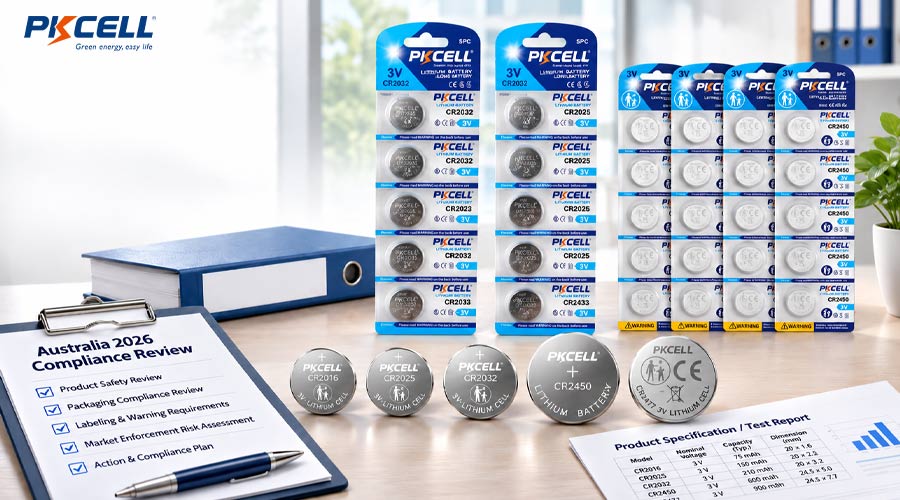
Australia’s 2026 enforcement developments focus on existing mandatory requirements. Businesses must verify applicable testing, battery compartment safety, packaging and warning information before supplying products.
1. Three Major Button Battery Enforcement Cases in 2026
Three ACCC enforcement developments demonstrate the financial and operational risks associated with non-compliant consumer products containing button batteries.
City Beach: $14 Million Penalty Upheld
The Full Federal Court dismissed City Beach’s appeal against a $14 million penalty. The original case involved more than 60 types of products containing button batteries, supplied on over 54,000 occasions between June 2022 and October 2024.
The products included toys, digital notepads, keyrings and lighting accessories. The decision demonstrates the serious financial consequences of failing to meet mandatory product safety and information standards.
Dusk Australasia: 66,453 Products Involved
The ACCC commenced proceedings against Dusk over 29 product lines, including candles, diffusers and LED decorative products. The ACCC alleges that 25 product lines were supplied without required pre-supply testing and four lacked required safety warnings.
The case highlights the importance of completing compliance testing before products enter the market. These remain allegations, not final court findings.
Kmart Australia: Watch and GPS Smart Tag Concerns
The ACCC commenced proceedings concerning Anko digital and analogue watches and GPS Smart Tags. The regulator alleges that approximately 64,000 watches were supplied without required pre-supply testing and that more than 800 smart tags did not meet applicable information requirements.
The case reinforces the need to verify both finished-product safety and mandatory warning information. The allegations have not yet been determined by the Court.
2. What Recent Product Recalls Reveal
Australian product recall notices have also highlighted problems in everyday products containing button batteries, including torches, keychain lights, watches and LED candles.
Three common issues stand out:
- Inadequate battery security: Battery compartments may allow children to access the batteries.
- Missing pre-supply testing: Products may enter the market without the required compliance assessment.
- Incomplete warnings: Mandatory safety information may be missing from packaging, products or instructions.
These concerns are not limited to toys. Importers should review all consumer products containing button batteries, including household accessories and electronic devices.
3. Four Mandatory Standards Suppliers Must Understand
Australia’s button battery requirements have applied since 22 June 2022. The framework consists of four mandatory safety and information standards.
| Mandatory Standard | Main Compliance Focus |
|---|---|
| Button and Coin Batteries Safety Standard | Child-resistant packaging for standalone batteries. |
| Button and Coin Batteries Information Standard | Required warnings and markings on standalone batteries and packaging. |
| Products Containing Button and Coin Batteries Safety Standard | Secure battery compartments and applicable pre-supply testing. |
| Products Containing Button and Coin Batteries Information Standard | Required safety warnings on products, packaging and instructions. |
For standalone lithium coin cells, such as CR2032, applicable requirements include child-resistant packaging and safety warnings. Lithium button batteries with a diameter of 20 mm or more must also carry the specified keep-out-of-reach-of-children symbol.
For finished consumer products, suppliers must assess the battery compartment and applicable warning requirements. A cell-level datasheet alone does not establish compliance of the complete device.
4. What Overseas Suppliers and Importers Should Do
The 2026 enforcement cases provide four practical lessons for businesses supplying button battery products to Australia.
Complete Testing Before Supply
Relevant testing should be completed before products are commercially supplied. Importers should verify that reports cover the actual product configuration and applicable requirements.
Verify Packaging and Battery Compartments
Review child-resistant packaging for standalone batteries and battery compartment security for finished products. Changes to fasteners, enclosures or packaging should trigger a compliance review.
Control Warning Labels and Product Documents
Check the required warnings across the battery, packaging, product, instructions and applicable online listings. Keep approved artwork versions linked to individual SKUs.
Maintain Traceability and Recall Procedures
Retain test reports, product drawings, batch information and supplier change records. Establish a process for investigating safety complaints, identifying affected products and coordinating corrective actions.
Suppliers who become aware of a death or serious injury or illness associated with a product they supplied must meet Australia’s mandatory reporting requirements, including the applicable two-day notification deadline.
5. Who Is Responsible in the Supply Chain?
Australian product safety responsibilities are not limited to the final retailer. Manufacturers, importers, distributors and retailers involved in supplying relevant products must understand their applicable obligations.
| Business Role | Key Responsibility |
|---|---|
| Battery Manufacturer | Provide accurate specifications, relevant battery evidence and packaging information. |
| Product Manufacturer | Verify finished-product design, battery compartment safety and applicable testing. |
| Australian Importer | Review compliance evidence and coordinate market-entry and recall procedures. |
| Distributor and Retailer | Check applicable product information, maintain records and respond to safety concerns. |
The exact legal obligations depend on the product and business role. Overseas suppliers should work with Australian importers to establish clear testing, documentation and product-change procedures.
6. Pre-Shipment Compliance Checklist
Before approving an Australian order, overseas manufacturers and importers should confirm the following:
- Product classification: Identify whether the shipment contains standalone batteries or finished consumer products.
- Applicable standards: Confirm the relevant safety and information requirements.
- Testing: Obtain applicable test reports for the final product configuration before supply.
- Packaging: Verify child-resistant packaging and secure battery compartments where required.
- Warnings: Approve battery markings, packaging, instructions and product warning artwork.
- Traceability: Retain product specifications, batch records, approved documents and change history.
Frequently Asked Questions
1. Did Australia introduce a new button battery regulation in 2026?
No. Australia’s four mandatory button battery safety and information standards took effect in June 2022. The 2026 cases demonstrate continued enforcement of existing requirements.
2. Are standalone CR2032 batteries covered by Australian requirements?
Yes. Applicable requirements include child-resistant packaging and safety information. Lithium button batteries with a diameter of 20 mm or more also require the specified safety symbol on each battery.
3. Is a battery test report sufficient for a finished consumer product?
Not necessarily. The finished device must also be assessed against applicable battery compartment, product testing and warning requirements. Cell-level documentation alone does not demonstrate complete product compliance.
Looking for a Reliable Lithium Button Battery Supplier?
PKCELL supplies primary lithium button cells for distributors, electronics manufacturers and OEM projects. Our range includes standard CR lithium coin cells and customized battery configurations with tabs or leads.
Share your required model, specifications, estimated quantity and target application with our team to discuss suitable products and available documentation.
Explore our Lithium Button Cell Battery Range and Customized Battery Services.
Conclusion
Australia’s 2026 enforcement actions show that button battery compliance requires more than a product specification sheet. Pre-supply testing, secure battery compartments, accurate warnings and traceable documentation are essential parts of a reliable supply process.
For overseas manufacturers and importers, reviewing these requirements before shipment can help reduce recall exposure and build stronger business relationships in the Australian market.
Post time: Nov-18-2026


