Cómo calcular la duración de la batería para dispositivos LoRaWAN y NB-IoT
La duración de la batería es uno de los objetivos de diseño más importantes para los dispositivos LoRaWAN y NB-IoT. Se espera que un contador inteligente, un sensor remoto, un rastreador de activos o un dispositivo de monitorización industrial funcione durante 5, 10 o incluso 15 años sin necesidad de cambiar la batería. Sin embargo, la duración real de la batería depende de mucho más que la capacidad nominal.
Conclusiones clave
La forma más práctica de estimar la duración de la batería es calcular la corriente promedio del ciclo completo del dispositivo y luego aplicar una reducción de potencia realista por temperatura, corriente de pulso, autodescarga, corte de voltaje, reintentos de red y envejecimiento.
Para dispositivos IoT industriales de larga duración, a menudo se prefieren las baterías de litio primarias, como las celdas LiSoCl2 ER y los paquetes de baterías ER + HPC, porque proporcionan una alta densidad de energía, una baja autodescarga y una larga vida útil.
1. La fórmula básica para calcular la duración de la batería.
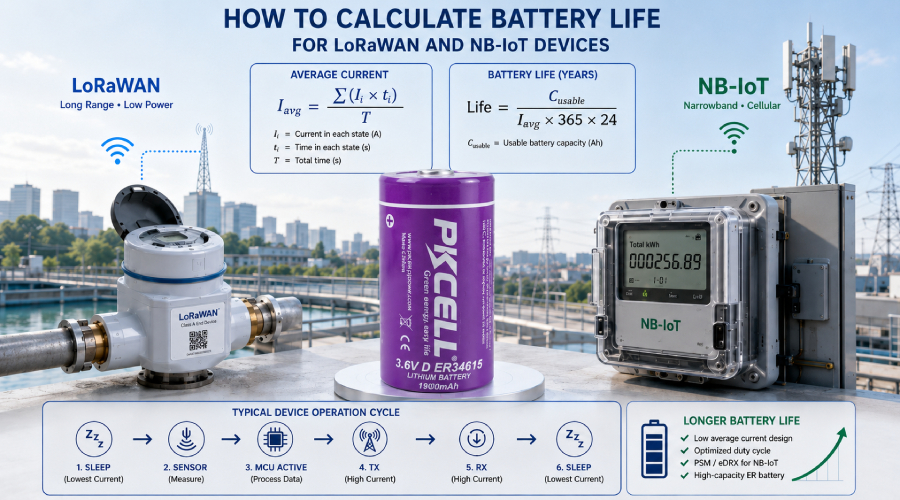
La fórmula más sencilla para determinar la duración de la batería es:
Fórmula simpleDuración de la batería (horas) = Capacidad útil de la batería (mAh) / Corriente media (mA)Duración de la batería (años) = Duración de la batería (horas) / 24 / 365
Esta fórmula es útil, pero solo es precisa si la corriente promedio se mide correctamente. Los dispositivos IoT no consumen la misma corriente todo el tiempo. Generalmente pasan la mayor parte del tiempo en modo de suspensión y luego se activan para detectar, procesar, transmitir de forma inalámbrica, recibir datos, realizar actividad de red y, a veces, retransmitir.
Fórmula más práctica para dispositivos IoT
Fórmula basada en ciclosCorriente promedio = Consumo total de carga por ciclo / Tiempo de cicloIavg = Σ(I × t) / T
Símbolo
Significado
I
Corriente en cada estado operativo, como reposo, detección, TX, RX o conexión de módem.
t
Duración de cada estado operativo
T
Tiempo total del ciclo, como por ejemplo un intervalo de informe.
Promedio
Corriente promedio utilizada para el cálculo de la duración de la batería.
Por qué la duración teórica de la batería no es suficiente
Un cálculo teórico presupone condiciones perfectas. Las implementaciones reales en campo son diferentes. Los cambios de temperatura, la calidad de la señal, la corriente de pulso, el envejecimiento de la batería, la autodescarga, la pasivación y la tensión de corte del dispositivo reducen la capacidad útil.
Estimación prácticaDuración práctica de la batería = Duración teórica de la batería × Factor de reducción de potencia
Nota de ingeniería
En proyectos de IoT industrial, los ingenieros no deben utilizar el 100 % de la capacidad nominal de la batería en los cálculos de vida útil. Se requiere un margen de seguridad para las condiciones de campo, el comportamiento de la red, el tiempo de almacenamiento y las variaciones de producción.
2. Estados de energía clave en dispositivos LoRaWAN y NB-IoT
Antes de calcular la duración de la batería, divida el dispositivo en estados de energía. Esto evita subestimar el consumo de energía.
Ciclo de alimentación típico de IoT
Dormir
Despertar
Detección
Procesamiento de MCU
TX
RX / Escuchar
Vuelve a dormir
Estado de potencia
Qué incluye
Impacto en la vida útil de la batería
Modo de suspensión
Modo de suspensión del microcontrolador, modo de espera del sensor, corriente de reposo del regulador, corriente de fuga
Fundamental para intervalos de informes prolongados, ya que el dispositivo puede permanecer inactivo durante más del 99% del tiempo.
Medición del sensor
Lectura de contadores, temperatura, presión, detección de gases, GNSS, acelerómetro u otros sensores.
Puede dominar el consumo de energía cuando los sensores requieren calentamiento, tiempos de muestreo prolongados o posicionamiento GNSS.
Procesamiento de MCU
Activación, procesamiento de datos, cifrado, preparación de paquetes, escritura en memoria.
Suele ser breve, pero aun así debería incluirse en cada ciclo.
Transmisión
Transmisión de datos mediante enlace ascendente LoRaWAN o NB-IoT
A menudo, el pico de corriente más grande en el ciclo del dispositivo
Recibir / Escuchar
Ventanas de recepción LoRaWAN, paginación NB-IoT, respuesta del servidor o temporizador activo
A menudo se ignora, pero puede reducir significativamente la duración de la batería.
3. Cómo calcular la duración de la batería para dispositivos LoRaWAN
Los dispositivos LoRaWAN se utilizan habitualmente en contadores inteligentes, sensores ambientales, sensores de aparcamiento, dispositivos de monitorización industrial y sistemas de seguimiento de activos. Para aplicaciones alimentadas por batería, se suele elegir el modo de operación Clase A, ya que minimiza el tiempo de recepción en comparación con los modos que escuchan con mayor frecuencia.
Fórmula para calcular la duración de la batería de LoRaWAN
Qcycle = Qsleep + Qsensor + Qmcu + Qtx + Qrx1 + Qrx2 + Qretry + QjoinIavg = Qciclo / Tiempo de cicloDuración de la batería = Capacidad útil / Iavg
Parámetro
Significado
Qsleep
Energía utilizada durante el modo de reposo
Qsensor
Energía utilizada por los sensores durante la medición
Qmcu
Energía utilizada por el encendido, el procesamiento, el cifrado y la escritura en memoria del MCU.
Qtx
Energía utilizada durante la transmisión LoRa
Qrx1 / Qrx2
Energía utilizada durante las ventanas de recepción después de un enlace ascendente
Reintentar
Energía adicional causada por mensajes confirmados, enlaces ascendentes fallidos o mala calidad de la señal.
Qjoin
Energía de unión o reunificación promediada durante la vida útil prevista.
Parámetros de LoRaWAN que afectan la duración de la batería
Factor
Impacto en la duración de la batería
Intervalo de enlace ascendente
Un intervalo más largo generalmente reduce la corriente promedio y prolonga la vida útil de la batería.
Tamaño de la carga útil
Una carga útil mayor puede aumentar el tiempo de emisión y la energía de transmisión.
Factor de propagación
Un factor de dispersión más alto aumenta el tiempo de transmisión y puede reducir la duración de la batería.
TX Power
Una mayor potencia de transmisión aumenta el consumo de corriente durante la transmisión ascendente.
Enlace ascendente confirmado
Los acuses de recibo y los reintentos pueden aumentar la energía de recepción y transmisión.
Configuración de ADR
Una estrategia de velocidad de datos adaptativa configurada correctamente puede reducir el tiempo de transmisión y el consumo de energía.
Calidad de la señal
Una cobertura deficiente puede aumentar los reintentos, la transmisión de alta potencia y el tiempo total de emisión.
Temperatura
Las bajas temperaturas pueden reducir la capacidad útil y aumentar la caída de tensión bajo carga.
Ejemplo de estructura de cálculo LoRaWAN
1Medir la corriente de reposo, incluyendo la corriente de reposo del MCU, los sensores, el RTC, la memoria y el regulador.
2Mida la corriente del sensor y el tiempo de funcionamiento del sensor para cada lectura.
3Medir la corriente activa del microcontrolador y la duración del procesamiento.
4Mida la corriente y el tiempo de transmisión de LoRa TX con una configuración realista de velocidad de datos y carga útil.
5Incluya las ventanas de recepción RX1 y RX2 después de cada enlace ascendente.
6Agregue un margen de reintento para mensajes confirmados, señal débil, cobertura de puerta de enlace y condiciones de instalación.
7Aplique reducciones de potencia por autodescarga, temperatura, pasivación y corte de voltaje.
4. Cómo calcular la duración de la batería para dispositivos NB-IoT
Los dispositivos NB-IoT utilizan infraestructura celular LPWAN y se emplean habitualmente en contadores de gas inteligentes, contadores de agua inteligentes, infraestructura urbana, monitorización industrial y equipos remotos. La duración de la batería depende no solo del firmware del dispositivo, sino también de la cobertura de red, la configuración del operador, PSM, eDRX, el comportamiento de conexión y las retransmisiones.
Fórmula para calcular la duración de la batería de NB-IoT
Qcycle = Qsleep + Qsensor + Qmcu + Qattach + Qtx + Qrx + Qpsm + Qedrx + QretryIavg = Qciclo / Tiempo de cicloDuración de la batería = Capacidad útil / Iavg
Estados de energía importantes de NB-IoT
Estado de potencia
Descripción
Sueño profundo
El dispositivo está inactivo y el microcontrolador, los sensores y el módem consumen una corriente mínima.
PSM
El modo de ahorro de energía permite que el dispositivo permanezca registrado mientras está en reposo, lo que reduce la necesidad de reconectarlo con frecuencia.
eDRX
La recepción discontinua extendida permite que el dispositivo escuche las llamadas a intervalos más largos.
Adjuntar / TAU
El registro en la red y la actualización del área de seguimiento pueden consumir una cantidad significativa de energía.
Transmisión de datos
Transmisión de datos de enlace ascendente, a menudo con alta corriente de pico y duración variable.
RX / Localización
Escucha de enlace descendente, respuesta del servidor, temporizador activo o ventanas de paginación
Búsqueda en red
Alto consumo de energía cuando la señal es débil, no hay cobertura o el dispositivo busca repetidamente servicio.
Parámetros de NB-IoT que afectan la duración de la batería
Factor
Impacto
Intervalo de notificación
Los intervalos más largos reducen el número de activaciones y transmisiones del módem.
Temporizador PSM
Un PSM más largo puede reducir el consumo de energía, pero los valores reales dependen del soporte de la red.
Ciclo eDRX
Un ciclo eDRX más largo reduce la frecuencia de escucha, pero aumenta la latencia de descarga.
Temporizador activo
Un tiempo de actividad más prolongado después de la transmisión aumenta el consumo de energía.
Intensidad de la señal
Una señal débil puede aumentar la potencia de transmisión, la retransmisión y el tiempo de búsqueda de red.
Carga útil y protocolo
MQTT, CoAP, UDP, TCP y el formato de la carga útil de la aplicación afectan la energía de transmisión.
Movilidad
Los dispositivos en movimiento pueden consumir más energía debido a la reselección de celdas y al cambio de cobertura.
Errores comunes sobre la duración de la batería en NB-IoT
Suponiendo que la configuración de PSM y eDRX se acepte siempre exactamente como la solicita el dispositivo.
Ignorando attach, TAU, temporizador activo y energía de búsqueda de red.
Utilizar condiciones de señal de laboratorio en lugar de cobertura de campo real.
No se están realizando mediciones con la tarjeta SIM, la red del operador, la antena, la carcasa ni el firmware reales.
Elegir una batería basándose únicamente en la capacidad nominal en mAh sin verificar la corriente de pulso ni la caída de voltaje.
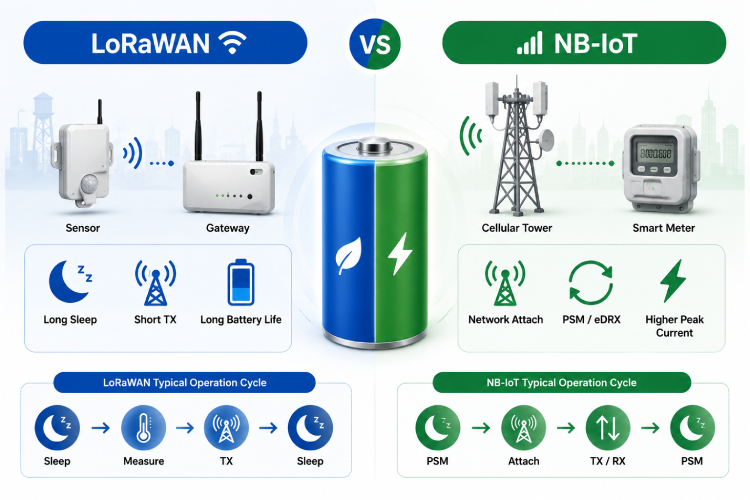
5. Duración de la batería en LoRaWAN frente a NB-IoT: ¿Cuáles son las diferencias?
Figura 1. Diferencias en el comportamiento de la duración de la batería entre dispositivos LoRaWAN y NB-IoT.
Artículo
LoRaWAN
NB-IoT
Tipo de red
LPWAN utilizando espectro no licenciado
Red LPWAN celular especificada por 3GPP
Aplicaciones típicas
Sensores, contadores, dispositivos de estacionamiento, monitoreo ambiental, seguimiento de activos
Contadores inteligentes, infraestructura urbana, monitorización industrial, seguimiento de activos
Optimización de la energía
Sueño prolongado, enlace ascendente corto, operación de Clase A, ADR y carga útil optimizados.
PSM, eDRX, conexión optimizada, menor tiempo de actividad, buena calidad de señal.
Riesgo energético
Tiempo de emisión prolongado, alto factor de propagación, reintentos, enlaces ascendentes confirmados
Energía de conexión, cobertura deficiente, búsqueda de red, retransmisión, temporizador activo prolongado
Problema con la batería
Corriente pulsada, ventanas RX, almacenamiento prolongado, temperatura
Mayor corriente máxima, eventos de transmisión más prolongados, caída de tensión, variabilidad de la red.
Batería recomendada
Batería LiSoCl2 ER, ER + HPC para aplicaciones de pulso alto
Batería LiSoCl2 ER, a menudo un paquete de baterías ER + HPC para corriente de pulso alta.
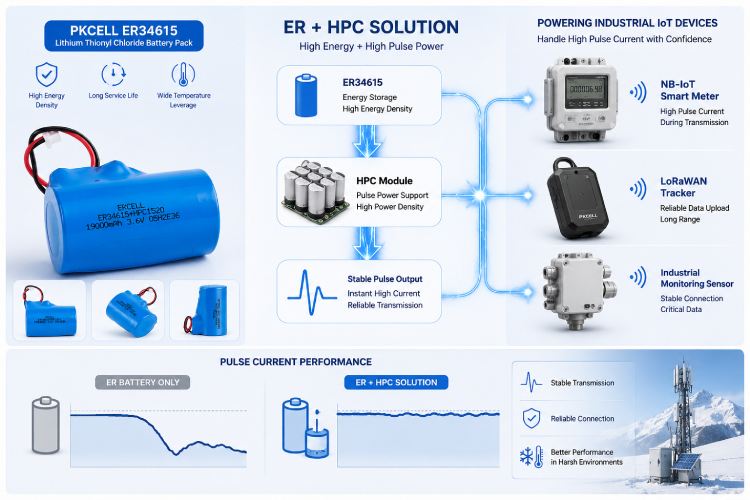
6. Selección de la química de la batería para dispositivos LoRaWAN y NB-IoT
Figura 2. La arquitectura ER + HPC proporciona soporte estable de corriente pulsada para transmisiones inalámbricas de IoT.
Dos baterías con la misma capacidad nominal pueden tener un rendimiento muy diferente en condiciones reales. Los proyectos de IoT de larga duración deben tener en cuenta la autodescarga, el rango de temperatura, la capacidad de pulsos, la plataforma de voltaje, el tiempo de almacenamiento, la resistencia interna y los requisitos de seguridad.
Tipo de batería
Ventajas
Limitaciones y casos de uso
Alcalino
Bajo costo y fácil disponibilidad
Mayor autodescarga y menor rendimiento a bajas temperaturas; adecuado para dispositivos de consumo de corta duración.
Batería recargable de iones de litio
Recargable y apto para alta corriente.
Requiere un circuito de carga y un diseño de protección; no es ideal para muchas aplicaciones de baterías primarias libres de mantenimiento.
LiMnO2
Salida estable de 3 V y buena capacidad de pulsos.
Común en alarmas, rastreadores, dispositivos inalámbricos y aplicaciones que requieren pilas de litio primarias de 3 V.
LiSoCl2 ER
Alta densidad de energía, baja autodescarga, larga vida útil, plataforma de voltaje estable
Excelente para contadores inteligentes, sensores remotos e IoT industrial; las aplicaciones de alta frecuencia de pulsos pueden requerir soporte adicional.
LiSoCl2 + HPC
Combina almacenamiento de energía de larga duración con una salida de pulsos mejorada.
Recomendado para NB-IoT, rastreadores GNSS, medidores de control de válvulas y dispositivos inalámbricos con corriente de ráfaga.
¿Cuándo utilizar los paquetes de baterías ER + HPC?
Dispositivos NB-IoT con alta corriente de transmisión máxima.
Rastreadores LoRaWAN con posicionamiento GNSS y enlaces ascendentes periódicos.
Contadores inteligentes con control de válvula o accionamiento por motor.
Aplicaciones en ambientes fríos donde la caída de tensión es más severa.
Dispositivos que requieren más de 10 años de vida útil con cargas de pulsos inalámbricas.
7. Factores de reducción de potencia que los ingenieros deben incluir
Factor de reducción de calificación
Por qué es importante
Temperatura
Las bajas temperaturas reducen la capacidad útil y aumentan la caída de voltaje; las altas temperaturas pueden aumentar el envejecimiento y la autodescarga.
Corriente pulsada
Una batería puede tener capacidad suficiente, pero fallar si no puede soportar la transmisión del módem, el arranque del GNSS o los pulsos de activación de la válvula.
Autodescarga
Incluso una baja autodescarga se vuelve importante en despliegues de 10 y 15 años.
Voltaje de corte
Los dispositivos dejan de funcionar cuando el voltaje cae por debajo del voltaje mínimo de funcionamiento, incluso si queda algo de capacidad.
Pasivación
Las celdas de LiSoCl2 pueden presentar un retardo de voltaje tras un almacenamiento prolongado o un funcionamiento con baja corriente; es necesario validar el perfil de carga y la compatibilidad con pulsos.
Comportamiento de la red
La cobertura débil, la retransmisión y un tiempo de actividad prolongado pueden consumir mucha más energía de la esperada.
Estimación de capacidad útilCapacidad disponible = Capacidad nominal - Pérdida por autodescarga - Pérdida por temperatura - Capacidad residual no utilizable
8. Ejemplos prácticos de cálculo de la duración de la batería
Ejemplo 1: Medidor de agua inteligente LoRaWAN
Parámetro
Configuración de ejemplo
Tipo de dispositivo
Medidor de agua inteligente LoRaWAN
Intervalo de informe
Cada 6 horas
Clase de dispositivo
Clase A
Carga útil
12 bytes
Target Life
10 años
Opción de batería
ER18505, ER26500, ER34615 o un paquete de baterías LiSoCl2 personalizado, según el perfil de corriente y los límites de tamaño.
Para este dispositivo, el ingeniero debe calcular el consumo de energía en modo de suspensión durante el intervalo completo de 6 horas, añadir el consumo activo de la detección y del microcontrolador, incluir la transmisión LoRa y dos ventanas de recepción, y, por último, añadir los márgenes de reintento y de temperatura.
Ejemplo 2: Medidor de gas NB-IoT
Parámetro
Configuración de ejemplo
Tipo de dispositivo
Medidor de gas inteligente NB-IoT
Intervalo de informe
Una vez al día
Modo de potencia
PSM habilitado, eDRX dependiendo de los requisitos de enlace descendente
Requisito de enlace descendente
Rara vez se registran enlaces descendentes, principalmente informes de enlaces ascendentes.
Target Life
De 10 a 15 años
Opción de batería
Paquete de baterías ER26500, ER34615 o ER + HPC para corriente de pulso alto.
Para NB-IoT, los ingenieros deben realizar pruebas con la red real del operador. La conexión, el tiempo de acceso (TAU), el temporizador activo, la intensidad de la señal, la retransmisión y el comportamiento del modo de ahorro de energía pueden tener un gran impacto en la duración real de la batería.
Calculadora sencilla de duración de la batería
Utilice esta sencilla calculadora para obtener una estimación rápida. No sustituye la medición real de corriente, las pruebas de temperatura ni la validación de la corriente pulsada.
El resultado de la duración de la batería aparecerá aquí.
9. Lista de verificación para el cálculo de la duración de la batería
Antes de elegir una batería, recopile la siguiente información. Estos datos permiten al proveedor de baterías y al ingeniero del dispositivo recomendar una solución de batería más segura y adecuada.
Datos requeridos
Por qué es importante
Corriente de reposo del dispositivo
Determina el consumo en modo de espera a largo plazo
Corriente activa del MCU
Afecta a cada ciclo de despertar
Corriente y duración del sensor
Importante para dispositivos con gran cantidad de mediciones.
Corriente y duración de la transmisión de radio
Gran consumidor de energía durante la comunicación inalámbrica
Corriente RX y tiempo de escucha
Importante para las ventanas de recepción de LoRaWAN y el tiempo activo de NB-IoT.
Intervalo de notificación
Determina el ciclo de trabajo y la corriente promedio.
calidad de la señal
Afecta la potencia de transmisión, la retransmisión, la búsqueda de red y el tiempo de emisión.
Temperatura de funcionamiento
Afecta a la capacidad útil, la resistencia interna y la estabilidad del voltaje.
Corriente máxima
Determina si se necesita ER + HPC u otra solución de soporte de pulsos.
Voltaje mínimo
Determina cuánta capacidad nominal de la batería es realmente utilizable por el dispositivo.
10. Cómo prolongar la duración de la batería en dispositivos LoRaWAN y NB-IoT
Optimización de firmware y red
Reduzca la frecuencia de los informes siempre que sea posible.
Optimice el tamaño de la carga útil y evite campos de datos innecesarios.
Utilice correctamente el modo de suspensión profunda para el microcontrolador, los sensores, el regulador y el módem.
Reduzca los mensajes de confirmación innecesarios en las aplicaciones LoRaWAN.
Utilice NB-IoT PSM y eDRX según los requisitos de enlace descendente de la aplicación.
Validar el consumo real de corriente con el firmware y la red finales.
Optimización de hardware y batería
Mejorar la posición de la antena y de la instalación para reducir los reintentos.
Seleccione una composición química de la batería adecuada para un funcionamiento primario de larga duración.
Verifique la corriente máxima y la caída de voltaje durante la transmisión y los eventos del sensor.
Agregue soporte para computación de alto rendimiento (HPC) cuando se requiera una corriente de pulso alta.
Aplique una reducción de potencia realista por temperatura y autodescarga.
Prueba realizada en condiciones reales de carcasa, antena, temperatura y red.
11. Baterías recomendadas para dispositivos LoRaWAN y NB-IoT
Para sensores LoRaWAN de bajo consumo
Tipo de batería recomendado: ER14250, ER14505, ER18505 o CR123A, según el voltaje, el perfil de corriente, el espacio disponible y la frecuencia de comunicación.
Aplicaciones adecuadas: sensores ambientales, sensores de estacionamiento, sensores de puertas, módulos inalámbricos de lectura de contadores y dispositivos de monitorización de bajo ciclo de trabajo.
Para contadores inteligentes y sensores industriales
Dirección de la batería recomendada: ER26500, ER34615 o paquete de baterías LiSoCl2 personalizado.
Aplicaciones adecuadas: contadores de agua inteligentes, contadores de gas inteligentes, contadores de calor, sensores de presión remotos, dispositivos de monitorización industrial e infraestructuras exteriores.
Para dispositivos NB-IoT y de alta frecuencia
Dirección de la batería recomendada: paquete de baterías ER + HPC, ER26500 + HPC, ER34615 + HPC o paquete de baterías personalizado con conector, cable, pestañas y carcasa.
Aplicaciones adecuadas: contadores inteligentes NB-IoT, sistemas de seguimiento de activos GNSS, contadores de control de válvulas, alarmas industriales, sistemas de seguimiento de la cadena de frío y equipos de telemetría remota.
¿Necesitas ayuda para elegir una batería?
Envíe a PKCELL la tensión de su dispositivo, la corriente en reposo, la corriente activa, la corriente máxima, el intervalo de transmisión, la temperatura de funcionamiento, la vida útil prevista, las limitaciones de tamaño y los requisitos del conector. Nuestros ingenieros pueden ayudarle a estimar la vida útil de la batería y recomendarle una celda LiSoCl2, una batería de la serie ER, una solución HPC o un paquete de baterías personalizado.
12. Preguntas frecuentes sobre la duración de la batería de LoRaWAN y NB-IoT
¿Cómo se calcula la duración de la batería de un dispositivo IoT?
La duración de la batería se calcula dividiendo la capacidad útil de la batería entre la corriente promedio. Para los dispositivos IoT, la corriente promedio debe incluir el tiempo de inactividad, la detección, el procesamiento del microcontrolador, la transmisión, las ventanas de recepción, la actividad de red, los reintentos y la reducción de potencia.
¿Por qué la batería de mi dispositivo LoRaWAN dura menos de lo esperado?
Las causas comunes incluyen un alto factor de propagación, una señal deficiente, enlaces ascendentes frecuentes, mensajes confirmados, retransmisión, una corriente de reposo elevada, baja temperatura y una química de la batería incorrecta.
¿Por qué NB-IoT consume más energía de la esperada?
El consumo de energía de NB-IoT puede aumentar debido a una señal celular débil, conexiones frecuentes a la red, un temporizador activo prolongado, problemas de configuración de PSM/eDRX, retransmisión, búsqueda de red y sobrecarga del protocolo.
¿Es LoRaWAN más eficiente energéticamente que NB-IoT?
Depende de la aplicación, el intervalo de reporte, la carga útil, la cobertura, la configuración de la red y el diseño del dispositivo. LoRaWAN se usa frecuentemente para aplicaciones de sensores con bajo consumo de datos y largos intervalos. NB-IoT es adecuado para despliegues celulares de área amplia, pero requiere una optimización cuidadosa de PSM, eDRX, la calidad de la señal y el comportamiento del módem.
¿Qué batería es la mejor para los sensores LoRaWAN?
Para sensores LoRaWAN de larga duración, se suelen usar baterías LiSoCl2 ER. Si el dispositivo tiene una corriente de pulso más alta, GNSS o ráfagas inalámbricas frecuentes, un paquete de baterías ER + HPC podría ser más adecuado.
¿Qué batería es la mejor para los dispositivos NB-IoT?
Los dispositivos NB-IoT suelen requerir una solución de batería que admita una alta corriente de pico y una larga vida útil. Las baterías LiSoCl2 ER o los paquetes de baterías ER + HPC se suelen elegir para contadores inteligentes, sistemas de seguimiento y dispositivos IoT industriales.
¿Por qué la capacidad nominal de la batería no es suficiente?
La capacidad nominal no refleja todas las condiciones de funcionamiento reales. La capacidad útil se ve afectada por la temperatura, la corriente de descarga, la carga de pulsos, la tensión de corte, la autodescarga, el tiempo de almacenamiento, la pasivación y el envejecimiento.
¿Necesito un HPC para mi paquete de baterías IoT?
La HPC resulta útil cuando el dispositivo presenta una alta corriente de pulso, como en la transmisión NB-IoT, el arranque GNSS, la activación de válvulas, los reintentos inalámbricos o el funcionamiento en entornos fríos. Ayuda a reducir la caída de tensión durante las ráfagas de corriente.
¿Es posible que un dispositivo funcione durante 10 años con una sola batería?
Sí, pero solo cuando el sistema tenga una corriente media baja, un comportamiento de comunicación optimizado, una química de batería adecuada, suficiente capacidad utilizable, baja autodescarga y validación en condiciones reales de campo.
¿Qué información debo proporcionar a un proveedor de baterías?
Proporcione el voltaje del dispositivo, la corriente en reposo, la corriente activa, la corriente pico, la duración de la transmisión/recepción, el intervalo de informes, el tamaño de la carga útil, la temperatura de funcionamiento, la vida útil prevista, el voltaje mínimo de corte, el límite de espacio, los requisitos del conector y los requisitos de certificación.
Conclusión: El cálculo de la duración de la batería comienza con datos de potencia reales.
La duración de la batería en LoRaWAN y NB-IoT no se puede estimar únicamente a partir de la capacidad nominal de la batería. Los ingenieros deben calcular la corriente promedio del ciclo completo del dispositivo y, a continuación, aplicar una reducción de potencia realista por temperatura, autodescarga, corriente de pulso, pasivación, corte de voltaje y comportamiento de la red.
Para proyectos de IoT industrial de larga duración, las baterías LiSoCl2 ER y los paquetes de baterías ER + HPC pueden proporcionar soluciones energéticas fiables para contadores inteligentes, sistemas de seguimiento de activos, sensores remotos y equipos de monitorización industrial.