

Primaire handleiding voor lithiumbatterijen
Handleiding voor LiSoCl2-batterijen: industriële toepassingen, technische overwegingen en selectiestrategieën voor apparaten met een lange levensduur.
Naarmate het industriële IoT, slimme infrastructuur en systemen voor bewaking op afstand wereldwijd blijven groeien, is een betrouwbare stroomvoorziening gedurende de gehele levensduur een belangrijke technische uitdaging geworden voor fabrikanten van apparaten en beheerders van infrastructuur.
Volgens Transforma Insights zal het aantal actieve IoT-apparaten wereldwijd naar verwachting rond de 29,4 miljard bedragen in 2030, gedreven door de snelle groei van slimme nutsvoorzieningen, industriële automatisering, verbonden logistiek en netwerken voor teledetectie. Naarmate deze implementaties op grotere schaal worden toegepast, vormen de kosten voor batterijvervanging en onderhoud een steeds belangrijkere operationele uitdaging.
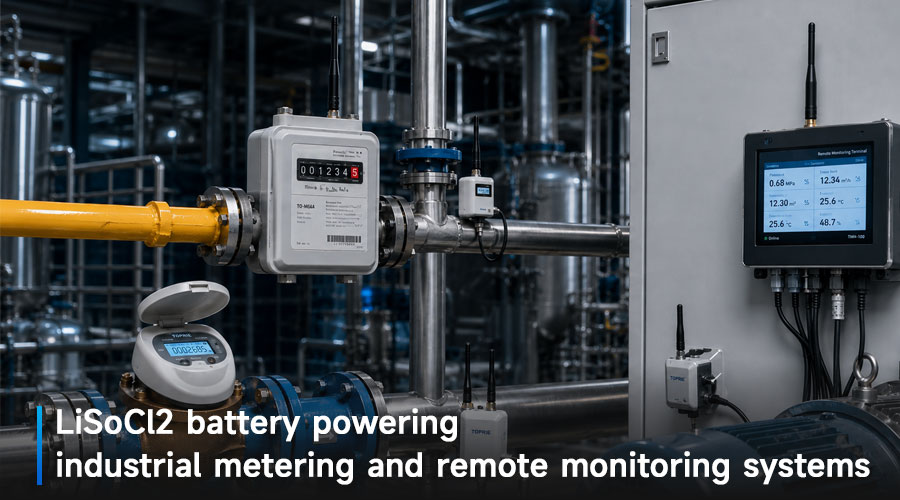
Implementatietype
Metering voor nutsbedrijven en de industrie
Slimme water- en gasmeters blijven vaak jarenlang in gebruik, waardoor de vervangingsfrequentie van de batterijen een belangrijke kostenpost vormt.
Implementatietype
Teledetectienetwerken
Draadloze industriële sensoren, apparatuur voor milieumonitoring en netwerken voor infrastructuurbewaking zijn afhankelijk van een lange levensduur van de noodstroomvoorziening.
Implementatietype
Telemetrie in ruwe omstandigheden
Telemetriesystemen en apparatuur voor het volgen van activa in de olie- en gassector werken vaak in gedistribueerde of moeilijk toegankelijke omgevingen.
Impact gedurende de levenscyclus
Onderhoudskosten stijgen snel
Bij grootschalige AMI-implementaties kan het verlengen van de batterijvervangingsintervallen met zelfs maar een paar jaar de onderhoudskosten op lange termijn aanzienlijk verlagen voor duizenden of miljoenen geïnstalleerde apparaten.
Om deze reden geven fabrikanten van industriële apparatuur steeds vaker prioriteit aan:
Van de beschikbare primaire lithiumbatterijtechnologieën is deLiSoCl2-batterij— ook wel bekend als delithiumthionylchloride-batterij— is uitgegroeid tot een van de meest gebruikte stroomoplossingen voor energiezuinige industriële elektronica.
In tegenstelling tot oplaadbare lithium-ionbatterijen die ontworpen zijn voor consumentenelektronica en toepassingen met hoge stroomsterkte, zijn LiSoCl2-batterijen specifiek ontwikkeld voor langdurig industrieel gebruik met een laag vermogen.
Tegenwoordig worden ze veelvuldig gebruikt in:
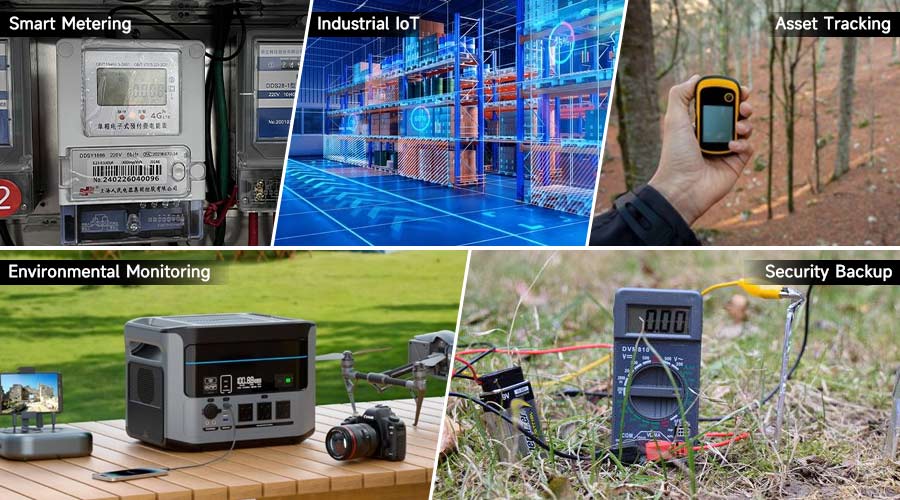
Slimme metersystemen
Gebruikt in nutsvoorzieningen die een lange standbytijd en weinig onderhoud gedurende een meerjarige gebruiksperiode vereisen.
LPWAN IoT-apparaten
Uitermate geschikt voor energiezuinige communicatiepatronen waarbij apparaten het grootste deel van de tijd in slaapstand staan en periodiek gegevens verzenden.
Draadloze sensorinfrastructuur
Ondersteunt langdurige veldimplementaties in industriële sensor-, telemetrie- en monitoringnetwerken.
Tracking- en back-upelektronica
Vaak gebruikt in GPS-systemen, apparatuur voor het volgen van objecten, apparatuur voor telemetrie op afstand en elektronische noodstroomvoorzieningen.
Dit artikel legt uit:
1
Hoe werkt de LiSoCl2-batterijtechnologie?
2
Waarom het veelvuldig wordt gebruikt in industriële toepassingen
3
Belangrijke technische overwegingen en implementatie-uitdagingen
4
Hoe industriële afnemers de juiste batterijoplossing kunnen selecteren
Wat is een LiSoCl2-batterij?
A LiSoCl2-batterijEen lithiumbatterij is een primaire (niet-oplaadbare) lithiumbatterij die lithiummetaal als anode en thionylchloride (SOCl2) als kathodemateriaal en elektrolytcomponent gebruikt.
Deze chemische samenstelling is specifiek geoptimaliseerd voor:
Extreem lage zelfontlading
Helpt de bruikbare capaciteit te behouden tijdens lange stand-byperioden en uitgebreide opslagcycli.
Langdurige stand-by-operatie
Geschikt voor apparaten die gedurende het grootste deel van hun levensduur inactief blijven en slechts periodiek ontwaken.
Stabiele ontlading bij lage stroomsterkte
Ondersteunt voorspelbare prestaties in energiezuinige industriële elektronica in plaats van in consumentenapparaten met een hoog stroomverbruik.
Lange opslagduur
Nuttig voor onderhoudsgevoelige infrastructuur en noodsystemen die een betrouwbare reserve-energievoorziening nodig hebben.
Vanwege deze eigenschappen worden LiSoCl2-batterijen veel gebruikt in industriële apparaten die naar verwachting meer dan 10 jaar onderhoudsvrij zullen functioneren.
De nominale spanning van een standaard lithium-thionylchloridebatterij bedraagt ongeveer 3,6 V, wat hoger is dan bij veel conventionele primaire batterijen. Deze hogere spanning kan het ontwerp van batterijpakketten vereenvoudigen en de energie-efficiëntie in energiezuinige elektronica verbeteren.
In tegenstelling tot oplaadbare lithium-ionbatterijen zijn LiSoCl2-batterijen primair ontworpen voor een lange gebruiksduur, stabiele noodstroomvoorziening en een onderhoudsarme werking, in plaats van herhaalde laad-ontlaadcycli.
Basisprincipes van batterijchemie
Het werkingsmechanisme van een lithium-thionylchloridebatterij is relatief eenvoudig:
1
Lithiummetaal fungeert als negatieve elektrode.
De anode levert de actieve lithiumbron die tijdens de ontlading wordt gebruikt.
2
Thionylchloride dient als positief elektrodemateriaal.
Het fungeert zowel als kathodemateriaal als elektrolytcomponent.
3
Elektrochemische reacties genereren elektrische energie.
De chemische samenstelling is ontworpen voor ontladingen met lage stroomsterkte en lange duur.
4
De praktische output is het meest geschikt voor standby-toepassingen.
Het ontwerp blinkt uit wanneer een lange opslagduur belangrijker is dan een hoge continue afvoercapaciteit.
Hoewel industriële afnemers de gedetailleerde elektrochemie niet per se hoeven te begrijpen, is inzicht in de praktische implicaties van deze chemie wel belangrijk.
Deze batterijstructuur maakt een zeer hoge energiedichtheid, een lange levensduur, een breed bedrijfstemperatuurbereik en een laag jaarlijks capaciteitsverlies mogelijk.
Een van de belangrijkste voordelen is het extreem lage jaarlijkse zelfontladingspercentage, dat onder normale opslagomstandigheden doorgaans lager is dan 1% per jaar.
In de praktijk is deze eigenschap zeer waardevol, omdat veel apparaten het grootste deel van hun levensduur in slaap- of stand-bymodus doorbrengen en periodiek kleine hoeveelheden data verzenden.
Bij deze systemen is een lange standbytijd vaak belangrijker dan een hoog continu ontladingsvermogen.
Belangrijkste kenmerken van LiSoCl2-batterijen
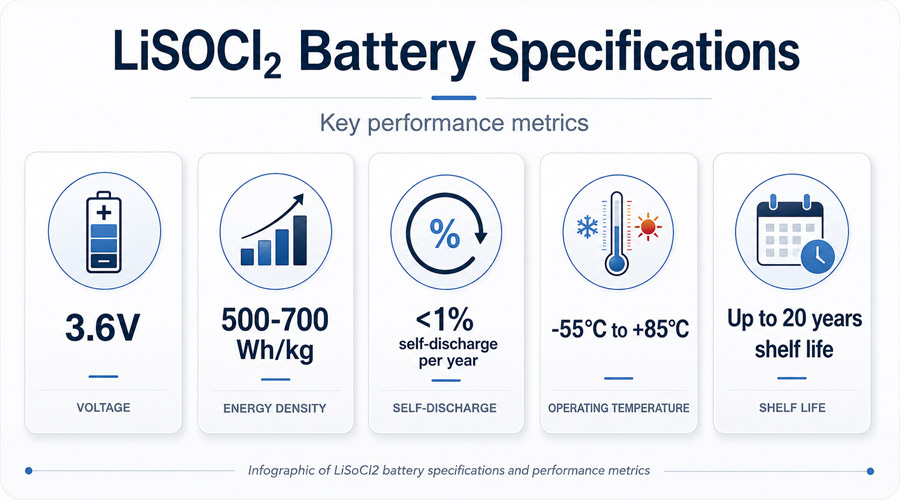
| Functie | Typische prestaties |
|---|---|
| Nominale spanning | 3,6V |
| Energiedichtheid | 500-700 Wh/kg |
| Jaarlijks zelfontslagpercentage | <1% per jaar |
| Houdbaarheid | Tot 20 jaar |
| Bedrijfstemperatuur | -55°C tot +85°C |
| Batterijtype | Primair (niet-oplaadbaar) |
| Gemeenschappelijke normen | IEC 60086, UL1642, UN38.3 |
IEC 60086 is een van de meest geraadpleegde internationale normen voor primaire batterijen en definieert prestatie- en veiligheidseisen voor industriële batterijtoepassingen.
De UN38.3-certificering is ook cruciaal voor naleving van internationale transportvoorschriften, met name voor wereldwijde OEM-toeleveringsketens die lithiumbatterijen over de hele wereld verzenden.
Waarom industriële apparaten vaak LiSoCl2-batterijen gebruiken
Industrie-ingenieurs beoordelen batterijen vaak anders dan ontwerpers van consumentenelektronica.
Bij industriële toepassingen is de belangrijkste vraag meestal niet:
Welke batterij heeft het hoogste vermogen?
De kernvraag is echter:
Welke batterij kan het apparaat gedurende de gehele gebruiksduur betrouwbaar van stroom voorzien met minimaal onderhoud?
Dit is een van de belangrijkste redenen waarom LiSoCl2-batterijen veelvuldig worden gebruikt in industriële infrastructuur.
Voordeel
Extreem lange levensduur
Een groot voordeel van de LiSoCl2-batterij is de lange levensduur. In energiezuinige industriële elektronica kan de levensduur vaak meer dan 10, 15 en in sommige gevallen bijna 20 jaar bedragen, afhankelijk van de communicatiefrequentie, de pulsstroombehoefte, de bedrijfstemperatuur en het stroomverbruik in slaapstand.
Voordeel
Ultralage zelfontlading
Veel industriële IoT-apparaten blijven gedurende het grootste deel van hun levensduur inactief en worden slechts periodiek geactiveerd om sensorgegevens te registreren, draadloze signalen te verzenden of de operationele status te rapporteren. Onder deze omstandigheden kan zelfontlading van de batterij een directe invloed hebben op de algehele levensduur.
Voordeel
Breed bedrijfstemperatuurbereik
In industriële omgevingen in de buitenlucht kunnen elektronische systemen worden blootgesteld aan extreme temperaturen. LiSoCl2-batterijen kunnen doorgaans functioneren bij temperaturen tussen -55 °C en +85 °C, waardoor ze geschikt zijn voor veeleisende toepassingen in het veld.
Bij de daadwerkelijke implementatie van slimme meters vormen batterijvervanging vaak een van de grootste operationele kosten op lange termijn.
Een nutsbedrijf kan honderdduizenden meters op geografisch verspreide locaties plaatsen. Zelfs relatief kleine verminderingen in de onderhoudsfrequentie kunnen de kosten voor het uitsturen van technici, transportkosten, serviceonderbrekingen en de complexiteit van de onderhoudsplanning aanzienlijk verlagen.
Om deze reden krijgen lithiumbatterijen met een lange levensduur doorgaans prioriteit bij de planning van nutsinfrastructuur.
Een lithium-thionylchloridebatterij verliest onder normale opslagomstandigheden doorgaans minder dan 1% van zijn capaciteit per jaar, waardoor deze uitermate geschikt is voor toepassingen met langdurige stand-by.
Bij sommige vroege IoT-toepassingen buitenshuis ontdekten ingenieurs dat standaard oplaadbare batterijen een aanzienlijk kortere gebruiksduur hadden bij koud weer. Als gevolg hiervan stapten veel industriële systeemintegratoren over op lithiumbatterijen, die beter geschikt zijn voor omgevingen met lage temperaturen.
LiSoCl2-batterijen bieden een zeer hoge energiedichtheid in vergelijking met veel traditionele primaire batterijen. Een typische energiedichtheid van 500-700 Wh/kg maakt kleinere apparaten, een langere gebruiksduur en een compact industrieel productontwerp mogelijk.
Bij LPWAN en draadloze sensoren, waar de interne ruimte beperkt is, is de energiedichtheid vaak belangrijker dan alleen de batterijkosten. Een hoge energiedichtheid is met name nuttig bij systemen voor het volgen van objecten, compacte draadloze sensoren, beveiligingsapparatuur en draagbare industriële elektronica.
Belangrijke technische overwegingen
Hoewel LiSoCl2-batterijen grote voordelen bieden, zijn ze niet ideaal voor elke toepassing.
Dit is een belangrijk onderwerp dat vaak over het hoofd wordt gezien in te simplistische artikelen over batterijen.
Voor een goede selectie van industriële batterijen is het niet alleen belangrijk om de sterke punten van de LiSoCl2-chemie te begrijpen, maar ook de technische beperkingen ervan.
Beperking
Beperkingen van pulsstroom
Standaard LiSoCl2-batterijen zijn voornamelijk geoptimaliseerd voor een lage continue stroom en een lange standby-tijd. Sommige draadloze communicatiemodules vereisen echter een hoge pulsstroom tijdens gegevensoverdracht.
Voorbeelden hiervan zijn NB-IoT-modules, GSM-communicatiesystemen en LoRaWAN-transmissiebursts.
Beperking
Spanningsvertraging en passivering
Na langdurige opslag of lange standby-perioden kunnen sommige LiSoCl2-batterijen tijdelijk een verlaagde spanning vertonen aan het begin van de ontlading. Dit verschijnsel wordt doorgaans in verband gebracht met passiveringseffecten op het lithiumoppervlak.
In sommige vroege IoT-projecten selecteerden ingenieurs batterijen uitsluitend op basis van de nominale capaciteit, terwijl ze de pulsstroombehoefte onderschatten. Dit leidde soms tot spanningsinstabiliteit, communicatiestoringen en een verminderde betrouwbaarheid van de transmissie.
Voor toepassingen met hoge pulssnelheden combineren systeemontwerpers vaak LiSoCl2-batterijen met Super Pulse Capacitors (SPC), hybride pulscondensatoren of parallelle condensatoroplossingen.
De batterijprestaties moeten altijd samen met de communicatiemodules, transmissie-intervallen, omgevingsomstandigheden en het stroomverbruik in slaapstand van het apparaat worden beoordeeld, en niet als een geïsoleerde component.
Bij de meeste toepassingen met lage stroomsterkte is spanningsvertraging beheersbaar door een goed systeemontwerp. Ingenieurs moeten echter tijdens de batterijselectie en veldtesten de initiële pulsstroomvereisten, de opstartspanningsdrempels en de bedrijfstemperatuuromstandigheden evalueren.
Gangbare industriële toepassingen van LiSoCl2-batterijen
Vanwege hun lange levensduur en stabiele prestaties bij lage stroomsterkte worden LiSoCl2-batterijen veelvuldig gebruikt in diverse industriële sectoren.
Sollicitatie
Slimme metersystemen
Een van de grootste toepassingen is het meten van nutsvoorzieningen, zoals watermeters, gasmeters en elektriciteitsmeters. Deze systemen vereisen vaak een levensduur van 10-15 jaar, weinig onderhoud, stabiele draadloze communicatie en een lange standby-tijd.
Sollicitatie
Industriële IoT-infrastructuur
Industriële IoT-systemen maken vaak gebruik van LPWAN-sensoren, apparatuur voor milieumonitoring, systemen voor voorspellend onderhoud en draadloze industriële sensoren. Het vervangen van batterijen in grote IoT-netwerken kan operationeel kostbaar worden, waardoor duurzame stroomoplossingen zeer waardevol zijn.
Sollicitatie
GPS en objectvolging
LiSoCl2-batterijen worden ook veel gebruikt in voertuigvolgsystemen, voor het monitoren van zeecontainers, in koelketenlogistiek en voor mobiel assetmanagement. Dankzij hun compacte formaat en lange levensduur zijn ze geschikt voor mobiele volgapparaten.
Sollicitatie
Beveiligings- en back-upsystemen
Andere toepassingen zijn onder meer rookmelders, alarmback-upsystemen, noodbewakingsapparatuur en beveiligingsinfrastructuur. Een lange levensduur en betrouwbare stand-byprestaties zijn met name belangrijk in noodsystemen.
Hoe kies je de juiste LiSoCl2-batterij?
Bij de keuze van de juiste batterij moeten zowel de elektrische prestaties als de gebruiksomstandigheden worden geëvalueerd.
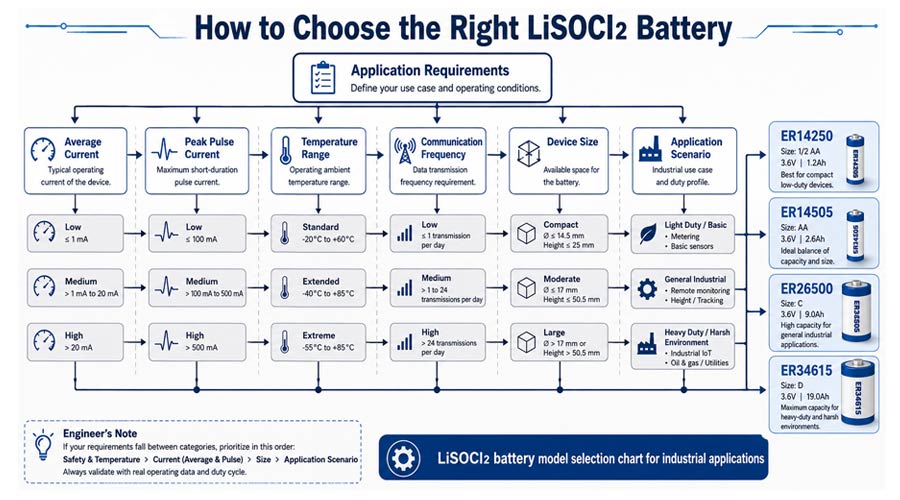
1
Evalueer het stroomverbruik van het apparaat.
Ingenieurs dienen de gemiddelde bedrijfsstroom, de piekpulsstroom, de slaapstroom en de communicatiefrequentie te evalueren.
2
Beoordeel de milieuomstandigheden
Een milieuevaluatie moet rekening houden met temperatuurbereik, luchtvochtigheid, blootstelling aan de buitenlucht en mechanische trillingen.
3
Kies het juiste batterijmodel.
Het optimale batterijmodel hangt af van de apparaatgrootte, de verwachte gebruiksduur, de huidige vraag en de omgevingsomstandigheden.
4
Controleer de kwalificaties van de leverancier.
Industriële afnemers moeten prioriteit geven aan naleving van regelgeving, transportgoedkeuring, stabiele productiecapaciteit en leveringsbetrouwbaarheid.
Het negeren van de pulsvraag tijdens de batterijselectie is een van de meest voorkomende fouten in het ontwerp van draadloze IoT-apparaten.
De prestaties van een batterij kunnen aanzienlijk variëren onder extreme omgevingsomstandigheden.
| Model | Typische capaciteit | Typische toepassingen |
|---|---|---|
| ER14250 | 1200mAh | Draadloze sensoren |
| ER14505 | 2700mAh | Slimme meters |
| ER26500 | 8500mAh | Industriële IoT |
| ER34615 | 19000mAh | Nutsinfrastructuur |
Bij grootschalige implementaties zijn consistentie in de productie en traceerbaarheid vaak net zo belangrijk als de specificaties van de batterij zelf.
Veiligheid en beste praktijken
LiSoCl2-batterijen zijn zeer betrouwbaar wanneer ze op de juiste manier worden gebruikt en geïntegreerd.
Industriële gebruikers dienen echter de juiste veiligheidsprocedures te volgen.
Veiligheidsregel
Niet opladen
LiSoCl2-batterijen zijn primaire lithiumbatterijen en zijn niet oplaadbaar. Pogingen om ze op te laden kunnen veiligheidsrisico's met zich meebrengen, zoals lekkage, interne schade en oververhitting.
Veiligheidsregel
Voorkom kortsluiting
Systeemontwerpers moeten externe kortsluitingen, mechanische schade en blootstelling aan overmatige hitte vermijden. Een goed ontwerp van de batterijhouder is belangrijk voor de industriële veiligheid.
Juiste opslagomstandigheden
Aanbevolen bewaarcondities zijn een koele, droge omgeving bij voorkeur tussen 5°C en 30°C. Correcte opslag draagt bij aan een lange houdbaarheid en een lage zelfontlading.
Veelgestelde vragen
Afhankelijk van het stroomverbruik en de bedrijfsomstandigheden kan de levensduur van het apparaat in energiezuinige industriële toepassingen variëren van 10 tot 20 jaar.
Spanningsvertraging wordt doorgaans geassocieerd met passivering na langdurige opslag of stand-bywerking met lage stroomsterkte.
Nee. Het zijn primaire lithiumbatterijen die ontworpen zijn voor eenmalig gebruik in industriële toepassingen.
Ja. Dankzij hun brede bedrijfstemperatuurbereik zijn ze uitermate geschikt voor zware industriële toepassingen in de buitenlucht.
Veelvoorkomende sectoren zijn onder andere slimme meters, industrieel IoT, olie en gas, beveiligingsinfrastructuur, logistieke tracking en milieumonitoring.
Conclusie
Naarmate het industriële IoT en slimme infrastructuur blijven groeien, wordt een betrouwbare stroomvoorziening gedurende de hele levensduur steeds belangrijker voor OEM-fabrikanten en infrastructuurbeheerders.
De LiSoCl2-batterijtechnologie is breed geaccepteerd vanwege de extreem lange levensduur, de lage zelfontlading, de hoge energiedichtheid, de betrouwbare prestaties buitenshuis en het brede bedrijfstemperatuurbereik.
Een succesvolle implementatie hangt echter niet alleen af van de chemische samenstelling van de batterij, maar ook van een goede systeemontwikkeling.
Industriële kopers zouden de vraag naar pulsstroom, het communicatiegedrag, de omgevingsomstandigheden, de levenscyclus van de implementatie en de consistentie van de leverancierskwaliteit moeten evalueren, in plaats van batterijen uitsluitend op basis van de nominale capaciteit te selecteren.
Voor industriële apparaten met een lange levensduur die in afgelegen of onderhoudsgevoelige omgevingen werken, blijven LiSoCl2-batterijen een van de meest betrouwbare primaire lithium-energieoplossingen die momenteel beschikbaar zijn.
Bent u van plan een langdurig primair lithiumproject te starten?
Gebruik deze handleiding als uitgangspunt voor productontwerp, leveranciersbeoordeling en toepassingsspecifieke batterijselectie, zodat uw implementatie gedurende de volledige levenscyclus betrouwbaar presteert.
Geplaatst op: 28 mei 2026


